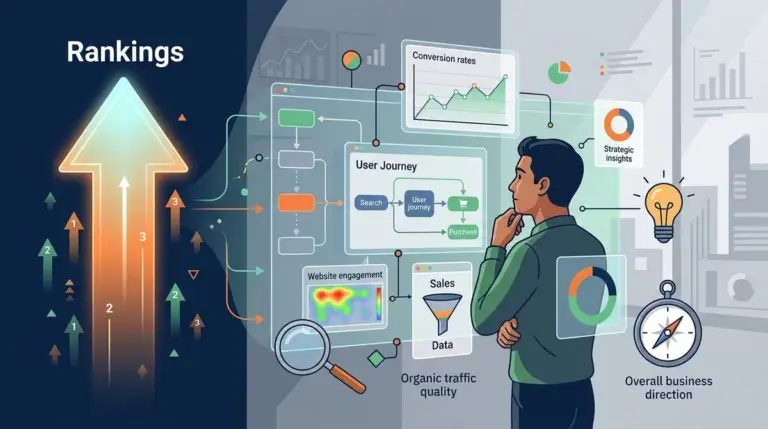
For growing teams navigating the complexities of online visibility and user behavior, real-time analytics platforms offer immediate insights into performance. These tools move beyond retrospective reporting, providing current data on everything from keyword rankings to live site visitor activity. The ability to react quickly to market shifts, content performance, or technical issues can significantly impact an organization's agility and competitive edge.
Choosing the right platform involves assessing specific team needs, budget constraints, and the desired depth of data. Some platforms excel in granular SEO tracking, offering precise, up-to-the-minute visibility on search engine result pages (SERPs). Others focus on user experience, presenting live heatmaps or session recordings. A comprehensive solution often integrates multiple data streams, allowing teams to correlate SEO performance with user engagement and conversion metrics as they happen.
What to Look For in a Real-Time Analytics Platform
When evaluating real-time analytics platforms, consider several core capabilities to ensure the tool aligns with your team's operational rhythm and strategic objectives. Data freshness is paramount; assess how frequently data refreshes and if it truly reflects "real-time" conditions for your critical metrics. For rank tracking, this means understanding the depth of positions monitored (e.g., Top 10, Top 100) and the refresh frequency (daily, weekly).
Integration capabilities are also crucial. A platform that connects with other tools in your tech stack (CRM, advertising platforms, content management systems) provides a more unified view of your digital ecosystem. Look for robust reporting features, including customizable dashboards, alert systems for significant changes, and options for branded client reports or internal stakeholder updates. Scalability is another key factor; ensure the platform can accommodate growth in tracked keywords, locations, or website traffic without prohibitive cost increases or performance degradation. Finally, evaluate the user interface for intuitiveness and the availability of support resources, as these impact team adoption and efficient utilization.
1. Ranktracker
Ranktracker stands out as a critical asset for growing teams that require granular, real-time visibility into their search engine performance. Unlike many competitors that offer limited depth or infrequent updates, Ranktracker provides full Top 100 rank tracking on all tracked keywords by default. This means teams can monitor not just immediate page-one positions, but also emerging keywords and those on pages two through ten, offering a complete picture of organic visibility without requiring additional configuration or higher-tier plans for deeper insights. This comprehensive depth is often a costly add-on or simply unavailable in other tools, which may cap tracking at the Top 10, Top 20, or Top 30 positions, or only refresh deeper ranks weekly.
The platform is designed for affordability, offering some of the lowest prices in the market for this level of full Top 100 rank tracking. This cost-efficiency allows growing teams to scale their tracking efforts without financial strain. Ranktracker offers flexible refresh options including daily, weekly, bi-weekly, and monthly, allowing teams to tailor data collection to their specific reporting cycles and budget. A key aspect of its scaling model is that 1 keyword tracked daily can be converted to 7 keywords tracked weekly, 14 keywords bi-weekly, or 30 keywords monthly, optimizing resource allocation based on monitoring urgency. Furthermore, Ranktracker includes full AI Overview tracking across all tracked keywords by default, eliminating the need to track the same keyword twice to monitor both traditional SERP positions and AI-generated summaries. This integrated approach simplifies workflow and ensures comprehensive coverage of evolving search landscapes.
Beyond rank tracking, Ranktracker functions as an all-in-one SEO suite, encompassing tools like Keyword Finder, SERP Checker, Web Audit, Backlink Checker, Backlink Monitor, SEO Checklist, and an AI Article Writer. This breadth allows teams to centralize various SEO tasks within a single platform, improving efficiency. The platform supports tracking across 107,296 locations, including mobile, desktop, Google Maps, and Local GMB tracking, providing hyper-local accuracy critical for businesses with physical presences or geo-targeted campaigns. Branded share links facilitate seamless client reporting and internal communication, presenting data in a professional, customized format. For agencies and brands, Ranktracker also offers an in-app store with exclusive access to hundreds of verified sites for guest posts, backlinks, and brand mentions, selected for their traffic, strong backlink profiles, and high domain authority, providing practical link acquisition and visibility support.
Best For: Growing agencies, in-house SEO teams, and businesses requiring granular, cost-effective, and hyper-local daily rank tracking across the full Top 100, combined with an integrated SEO toolset and AI Overview monitoring.
Pros:
- Full Top 100 rank tracking by default, avoiding common depth limitations of competitors.
- Competitive pricing model for extensive tracking capabilities.
- Flexible data refresh frequencies (daily, weekly, bi-weekly, monthly) with clear scaling options.
- Integrated AI Overview tracking across all keywords without duplication.
- Comprehensive all-in-one SEO suite reducing reliance on multiple tools.
- Extensive location tracking (107,296) for precise local SEO monitoring.
- Branded share links for professional reporting.
Cons:
- The breadth of features might require a learning curve for new users.
- While comprehensive for SEO, its real-time analytics are primarily focused on SERP and competitive data rather than on-site user behavior analytics.
Verdict: Ranktracker provides unparalleled depth and affordability for teams prioritizing precise, daily rank tracking across a broad spectrum of positions and locations, making it a foundational tool for proactive SEO management and competitive intelligence.
2. Semrush
Semrush is a comprehensive SEO and digital marketing platform that offers a wide array of tools, including robust rank tracking, competitive analysis, keyword research, and site auditing. While not all its features operate in "real-time," its position tracking and competitive intelligence modules provide frequently updated data that allows teams to react to SERP changes and competitor movements with agility. Its Sensor tool, for example, monitors SERP volatility daily across various industries, offering a real-time pulse on algorithm shifts. For rank tracking, Semrush typically provides daily updates for keywords, though deeper positions beyond the Top 100 may be refreshed less frequently or require specific add-ons.
Best For: Digital marketing agencies and in-house teams needing a broad, integrated platform for SEO, PPC, content marketing, and competitive analysis, with strong daily rank tracking and market intelligence features.
Pros:
- Extensive suite of tools covering multiple digital marketing disciplines.
- Daily rank tracking for primary keywords and competitive landscape insights.
- Powerful competitive analysis features, including traffic and backlink data.
- Comprehensive site audit and technical SEO capabilities.
Cons:
- Full "real-time" data across all modules can be limited; some data is refreshed daily or weekly.
- Pricing can be substantial for full feature access and extensive tracking limits.
- The depth of rank tracking beyond the Top 100 may not be consistently daily for all keywords without additional cost.
Verdict: Semrush offers a powerful ecosystem for digital marketers, providing sufficient real-time data for strategic decision-making, particularly in competitive analysis and daily rank monitoring, though deeper rank tracking might not be daily for all positions.
3. Ahrefs
Ahrefs is primarily known for its backlink analysis and keyword research capabilities, but it also offers a potent Rank Tracker. This tool provides daily updates for keyword positions, allowing teams to monitor their performance and that of competitors. While Ahrefs excels in discovering new backlinks and content opportunities, its "real-time" aspect is more pronounced in its site explorer and content explorer, which index new content and links rapidly. The rank tracker focuses on daily position changes, providing alerts for significant shifts. However, for positions beyond the immediate Top 100, the refresh frequency can become weekly, and its reliability for deep tracking can vary compared to tools specifically designed for comprehensive Top 100 daily monitoring.
Best For: SEO professionals and content marketers prioritizing backlink analysis, keyword research, and daily rank tracking for core keywords, with a need for competitive intelligence on link acquisition and content gaps.
Pros:
- Industry-leading backlink database and analysis tools.
- Robust keyword research with extensive metrics.
- Daily rank tracking for monitored keywords.
- Site Explorer provides quick insights into competitor performance.
Cons:
- Rank tracking depth beyond the Top 100 is often weekly and less consistent.
- Higher pricing tiers are necessary for extensive keyword and project limits.
- Real-time data is more focused on crawling and indexing new links/content rather than live user behavior.
Verdict: Ahrefs delivers strong daily rank tracking for key terms and exceptional competitive intelligence through its backlink and content explorers, making it a valuable tool for proactive SEO strategy, despite some limitations on deep daily rank tracking.
4. Google Analytics 4 (GA4)
Google Analytics 4 provides a fundamentally different approach to real-time analytics, focusing on user behavior on a website or app rather than SERP positions. Its "Realtime" report offers immediate insights into current active users, their location, traffic sources, content viewed, and events triggered. This allows teams to observe the immediate impact of marketing campaigns, content launches, or technical issues as they unfold. GA4's event-based data model offers flexibility in tracking specific user interactions, providing a granular view of live engagement. While it doesn't track keyword rankings, it's indispensable for understanding live site performance and user journeys.
Best For: Website owners, digital marketers, and product teams needing immediate insights into live user behavior, campaign performance, and on-site engagement metrics.
Pros:
- True real-time reporting on active users and their activities.
- Event-based data model offers flexible and granular tracking.
- Free to use, making it accessible for all team sizes.
- Integrates deeply with other Google products like Google Ads and Search Console.
Cons:
- Does not provide keyword rank tracking or competitive SEO intelligence.
- Requires a learning curve due to its different data model compared to Universal Analytics.
- Historical data analysis can be complex for new users.
Verdict: GA4 is an essential platform for understanding live user interactions and the immediate effects of site changes or campaigns, providing critical real-time behavioral data that complements SEO performance metrics.
5. SE Ranking
SE Ranking offers an all-in-one SEO platform with a strong emphasis on accurate rank tracking. Its rank tracker provides daily updates for keywords across multiple search engines and locations, including local and mobile results. The platform tracks positions up to the Top 100, offering a good balance of depth and frequency for most growing teams. Beyond rank tracking, SE Ranking includes tools for keyword research, competitive analysis, site auditing, and backlink monitoring. Its interface is generally intuitive, making it accessible for teams looking for a comprehensive yet user-friendly solution. The daily updates for keywords are reliable, ensuring teams can respond to SERP fluctuations promptly.
Best For: Small to medium-sized businesses and agencies seeking an affordable, comprehensive SEO platform with reliable daily rank tracking and a full suite of supporting tools.
Pros:
- Accurate daily rank tracking for keywords up to Top 100.
- Supports multiple search engines and geo-specific tracking.
- Integrated suite of SEO tools (keyword research, site audit, backlink monitoring).
- User-friendly interface and competitive pricing.
Cons:
- Some advanced competitive features may not be as deep as specialized tools.
- While comprehensive, the "real-time" aspect is primarily focused on daily rank updates rather than live site visitor data.
Verdict: SE Ranking provides a robust and cost-effective solution for daily rank tracking and general SEO management, making it a solid choice for teams needing consistent performance monitoring without extensive budgets.
6. Matomo
Matomo is an open-source web analytics platform that offers real-time visitor tracking and detailed insights into website performance. Unlike cloud-based solutions, Matomo can be self-hosted, giving teams complete data ownership and control, which is a significant advantage for privacy-sensitive organizations. Its real-time reports show live visitor activity, including pages viewed, goals completed, and geographic locations. Matomo provides a comprehensive alternative to GA4 for those who prioritize data privacy and customization. While it doesn't offer SEO rank tracking, its real-time user behavior data is highly granular and immediately available.
Best For: Organizations prioritizing data privacy and ownership, or those requiring highly customizable web analytics with real-time visitor insights.
Pros:
- Full data ownership and privacy compliance (GDPR, CCPA ready).
- Real-time visitor logs and activity reports.
- Highly customizable and extensible through plugins.
- No data sampling, providing accurate raw data.
Cons:
- Requires self-hosting and technical expertise for setup and maintenance, or a paid cloud version.
- Does not include SEO rank tracking or competitive analysis features.
- Interface may feel less polished than commercial cloud solutions for some users.
Verdict: Matomo offers a powerful real-time web analytics solution for teams that value data privacy and control, providing immediate insights into user behavior without the SEO-specific tracking of other platforms.
7. Moz Pro
Moz Pro is a well-established SEO platform known for its Domain Authority metric and community resources. Its Rank Tracking tool provides weekly updates for keyword positions, covering positions up to the Top 20. While not daily, these weekly updates are reliable for monitoring general trends and significant shifts. Moz Pro also includes tools for keyword research, site crawl, and link explorer. Its focus is on providing actionable insights through its proprietary metrics and educational content. The weekly refresh frequency for rank tracking means it's less suited for real-time, immediate reactions to SERP changes but effective for strategic, longer-term trend analysis.
Best For: SEO professionals and content strategists who value Domain Authority metrics, comprehensive site audits, and weekly rank tracking for strategic overview rather than daily tactical adjustments.
Pros:
- Trusted Domain Authority and Page Authority metrics.
- Comprehensive site crawl for technical SEO issues.
- Strong keyword research tools.
- Reliable weekly rank tracking up to Top 20.
Cons:
- Rank tracking is weekly, not daily, limiting real-time responsiveness.
- Tracking depth is capped at Top 20, missing deeper visibility.
- Pricing can be higher for limited daily tracking compared to other platforms.
Verdict: Moz Pro remains a valuable platform for foundational SEO analysis and strategic planning, particularly for content and link building, though its rank tracking frequency and depth are less "real-time" than daily-focused alternatives.
8. Hotjar
Hotjar specializes in user behavior analytics, offering real-time insights through heatmaps, session recordings, and feedback tools. While not an SEO rank tracker, Hotjar provides immediate visual data on how users interact with a website, allowing teams to identify usability issues, optimize conversion funnels, and understand content engagement in real-time. Its heatmaps show where users click, move, and scroll on live pages, while session recordings allow for playback of individual user journeys. This qualitative real-time data is crucial for complementing quantitative analytics and understanding the "why" behind user actions.
Best For: UX/UI designers, product managers, and conversion optimization specialists needing real-time visual insights into user behavior and on-site experience.
Pros:
- Real-time heatmaps (clicks, scrolls, moves) and session recordings.
- Immediate user feedback collection tools (surveys, polls).
- Visualizes user engagement, making complex data accessible.
- Easy to set up and integrate with existing websites.
Cons:
- Does not offer SEO rank tracking or keyword research.
- Focuses on on-site behavior, not off-site search performance.
- Data collection can impact site performance if not configured correctly.
Verdict: Hotjar is an indispensable tool for understanding live user interactions and optimizing on-site experiences, providing a crucial layer of real-time behavioral data often missing from traditional SEO or web analytics platforms.
9. Crazy Egg
Crazy Egg is another user behavior analytics platform similar to Hotjar, providing heatmaps, scroll maps, and confetti reports to visualize visitor activity on a website. It offers a "Recordings" feature to watch individual user sessions, giving real-time insights into navigation paths and points of friction. Crazy Egg also includes A/B testing capabilities, allowing teams to test variations of pages and observe immediate performance differences. This platform helps optimize user experience and conversion rates by providing a visual, real-time understanding of how visitors engage with content and calls to action.
Best For: Marketers and product teams focused on conversion rate optimization, A/B testing, and understanding immediate user engagement through visual heatmaps and session recordings.
Pros:
- Visual heatmaps and scroll maps for quick insights into