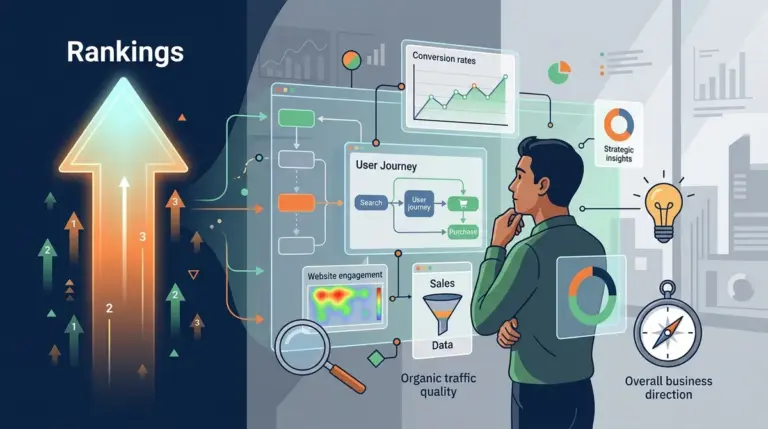

SEO reporting is the bridge between technical execution and business value. For beginners, the temptation is to dump every available metric from Google Search Console and GA4 into a slide deck, assuming that more data equals more transparency. In reality, a report that lacks a narrative or fails to connect organic performance to revenue is often ignored by stakeholders. Effective reporting filters out the noise to show how specific optimizations influenced the bottom line.
Confusing Vanity Metrics with Growth Indicators
The most common mistake in entry-level SEO reporting is over-emphasizing keyword rankings without context. While seeing a target term move from position 12 to position 4 is a positive signal, it is a vanity metric if that keyword carries zero transactional intent or has a negligible search volume. Stakeholders care about rankings only insofar as they drive qualified traffic and conversions.
Best for: Ensuring client retention and budget approval.
Instead of leading with a list of 50 keywords, lead with "Organic Conversions" or "Assisted Conversions." If rankings improved but traffic stayed flat, the report should investigate whether the keywords gained were low-volume or if the Click-Through Rate (CTR) suffered due to poor meta descriptions or aggressive SERP features like AI Overviews. A sharp editor looks for the "why" behind the rank, not just the number itself.
Failing to Segment Brand vs. Non-Brand Traffic
Beginners often report on "Total Organic Traffic" as a single lump sum. This is a critical error because brand traffic (users searching for the company name) and non-brand traffic (users searching for solutions or products) behave differently and reflect different marketing efforts. If a company runs a massive TV ad campaign, organic traffic will spike because people are searching for the brand. An SEO who takes credit for this without segmenting the data is providing an inaccurate representation of their work. This is a critical error because brand traffic and non-brand traffic behave differently, so understanding how to use Google Analytics for SEO learning requires segmenting the data.
- Brand Traffic: Reflects brand awareness, offline marketing, and PR. It usually has a high conversion rate and low bounce rate.
- Non-Brand Traffic: Reflects the success of content strategy, technical SEO, and keyword targeting. This is where the SEO’s direct impact is most visible.
- The Risk: If brand traffic drops due to a PR crisis but non-brand traffic grows due to SEO, a non-segmented report will simply show "flat" performance, hiding the SEO's success.
Relying Solely on Month-over-Month Comparisons
Reporting that February traffic is down 10% compared to January is often meaningless. Seasonality dictates the ebb and flow of almost every industry. A retail site will always see a drop in January compared to December; a tax software site will always see a spike in April. Beginners who rely on Month-over-Month (MoM) data often find themselves "explaining away" natural dips rather than highlighting real trends.
Professional reporting prioritizes Year-over-Year (YoY) comparisons. Comparing June 2024 to June 2023 accounts for seasonal fluctuations and provides a clearer picture of whether the site is actually growing. If YoY traffic is up 20%, the SEO strategy is working, even if MoM traffic is down due to a holiday period or a shorter month.
Warning: Avoid "Data Puking." This occurs when a reporter includes every chart available in a tool without explaining what the data means for the business. If a chart doesn't lead to an actionable insight or a specific decision, remove it from the report entirely.
Using Technical Jargon Without Business Translation
An SEO report for a CMO or a business owner should not read like a technical audit. Beginners often fill reports with terms like "LCP," "CLS," "canonicalization," and "crawl budget." While these are vital for the execution team, they are hurdles for a decision-maker who wants to know if the investment is paying off.
Every technical metric must be translated into business impact. For example, instead of saying "We improved LCP by 1.2 seconds," say "We improved site loading speed by 30%, which contributed to a 5% reduction in mobile bounce rate." This connects the technical labor to the user experience and, ultimately, the conversion funnel.
Neglecting the "Action Items" and "Next Steps"
A report is a historical document, but its value lies in how it shapes the future. A common beginner mistake is ending the report with the data, leaving the reader to wonder what happens next. Every report must conclude with a clear set of action items based on the data presented.
If the data shows a drop in traffic to a specific category page, the "Next Steps" section should outline a plan to refresh the content, check for broken internal links, or analyze competitor movements. This proactive approach transforms the SEO from a "data reporter" into a "strategic partner." It demonstrates that you are not just watching the numbers, but actively managing the site's health.
Ignoring the Impact of Algorithm Updates
When traffic fluctuations occur, beginners often scramble to find a specific technical error on the site. However, organic performance is frequently dictated by external factors, specifically Google Core Updates. A report that fails to mention a documented algorithm update that coincided with a traffic shift is incomplete.
Contextualizing performance within the broader search landscape protects the SEO’s credibility. If the entire niche saw a 20% volatility spike due to a "Helpful Content" update, and your site only saw a 5% dip, that is actually a sign of resilience. Without that context, the 5% dip looks like a simple failure.
Building a Repeatable Reporting Workflow
To avoid these mistakes, establish a template that prioritizes high-level business goals before diving into granular data. Start with a summary of wins, losses, and opportunities. Use automated dashboards to pull the raw data, but always add a manual layer of "Executive Summary" text to provide the narrative. Ensure your data sources are clean—verify that bot traffic is filtered in GA4 and that tracking codes are firing correctly on all lead-generation forms. By focusing on YoY growth, non-brand segmentation, and actionable insights, you move from reporting on the past to engineering future growth.
Frequently Asked Questions
How often should I send SEO reports?
Monthly reporting is the industry standard for most clients, as SEO changes take time to manifest. However, for high-velocity e-commerce sites or during a site migration, weekly "pulse" reports focusing on specific KPIs can be necessary.
What is the most important metric in an SEO report?
There is no single "most important" metric, but Organic Conversions (leads, sales, or sign-ups) is generally the most valued by stakeholders. If you cannot track conversions, Organic Sessions is the next best proxy for growth.
Should I include "lost" keyword rankings in my report?
Yes. Transparency builds trust. If you lose a major ranking, explain why it happened—whether it was a competitor's superior content, a technical issue, or an algorithm shift—and provide a specific plan to recover the position.
How do I report on SEO for a brand new website?
For new sites, conversions and traffic will be low. Focus on "leading indicators" like impressions, the number of indexed pages, and growth in average position. These show that Google is beginning to recognize and trust the site before the traffic follows.