A top-three ranking for a high-volume keyword often fails to generate a single dollar in revenue if the intent behind the query does not match the landing page offer. For years, SEO reporting focused almost exclusively on the "green arrow" of upward movement in search engine results pages (SERPs). However, as Google evolves into an answer engine and user behavior shifts toward specific, fragmented journeys, raw ranking data has become a secondary metric. To drive actual business growth, marketers must look past the position number and evaluate the quality of the traffic, the layout of the SERP, and the post-click experience.
The Diminishing Returns of Raw Position Metrics
In a traditional SEO framework, hitting the number one spot was the ultimate goal. Today, that position is frequently pushed below the fold by a combination of sponsored listings, Local Packs, Featured Snippets, and "People Also Ask" boxes. A site ranking in the first organic position might actually be the fifth or sixth clickable element on a mobile screen. This "SERP crowding" means that a high rank no longer guarantees a high click-through rate (CTR).
Best for: Agencies and internal teams who need to justify SEO spend to stakeholders who only care about the bottom line.
When evaluating the value of a ranking, you must consider "pixel height." If your organic listing is 1,200 pixels down the page, your visibility is effectively lower than a site ranking third in a cleaner, less competitive SERP layout. Relying on rank alone ignores the reality of how users interact with modern search interfaces. You are competing for attention, not just a numerical slot.
Warning: High rankings on broad, short-tail terms often lead to inflated bounce rates if the page content is too general. Narrow your focus to long-tail variants where the user's specific problem is clearly defined and your solution is the obvious next step.
Intent Mismatch: The Silent Conversion Killer
The most common reason a high-ranking page fails to convert is an intent mismatch. Google categorizes search intent into four primary buckets: informational, navigational, commercial, and transactional. If you rank #1 for an informational query like "how to calculate ROI" with a hard-sell product page, users will bounce immediately. They are looking for a formula or a calculator, not a sales pitch.
To fix this, you must audit the top-performing results for your target keywords. If the SERP is filled with blog posts and guides, your product page will never convert, regardless of its rank. Conversely, if the SERP is filled with category pages and product listings, your long-form educational article may rank well but will likely suffer from low engagement because the user is in a "buying" mindset, not a "learning" mindset.
Informational vs. Transactional Value
Informational rankings are excellent for top-of-funnel brand awareness and building retargeting audiences. However, they should not be measured by the same conversion benchmarks as transactional keywords. A successful SEO strategy balances these by using informational content to build authority and transactional content to capture revenue. If your reporting doesn't distinguish between these types of traffic, your ROI calculations will be fundamentally flawed.
The CTR Gap: Why Position One Isn't Always the Most Clicked
Rankings are a measure of relevance and authority in the eyes of an algorithm, but the click is a human decision. A site in position two with a compelling, benefit-driven meta description and a clear call-to-action in the title tag will often out-earn the site in position one that uses a generic, keyword-stuffed title.
Factors that influence CTR beyond rank include:
- Schema Markup: Review snippets, price points, and FAQ schema make your listing physically larger and more visually appealing.
- Brand Affinity: Users are more likely to click a known brand in position four than an unknown site in position one.
- Title Tag Relevance: Addressing the user's specific pain point directly in the title.
- URL Structure: A clean, descriptive URL builds trust more effectively than a string of random parameters.
Post-Click Behavior and the Revenue Connection
If SEO ends at the click, it is not a commercial strategy; it is a technical exercise. Once a user lands on your site, the ranking has done its job, and the responsibility shifts to User Experience (UX) and Conversion Rate Optimization (CRO). A high rank for a high-value term is a wasted asset if the page load time is over three seconds or if the mobile navigation is broken.
Analyze your "Time on Page" and "Pages per Session" for your top-ranking keywords. If users are leaving within seconds, your content is either not meeting the promise of the meta description, or the technical barriers are too high. High rankings without engagement are a signal to search engines that your result is not helpful, which will eventually lead to a decline in those very rankings you worked so hard to achieve.
Aligning SEO Reporting with Business Outcomes
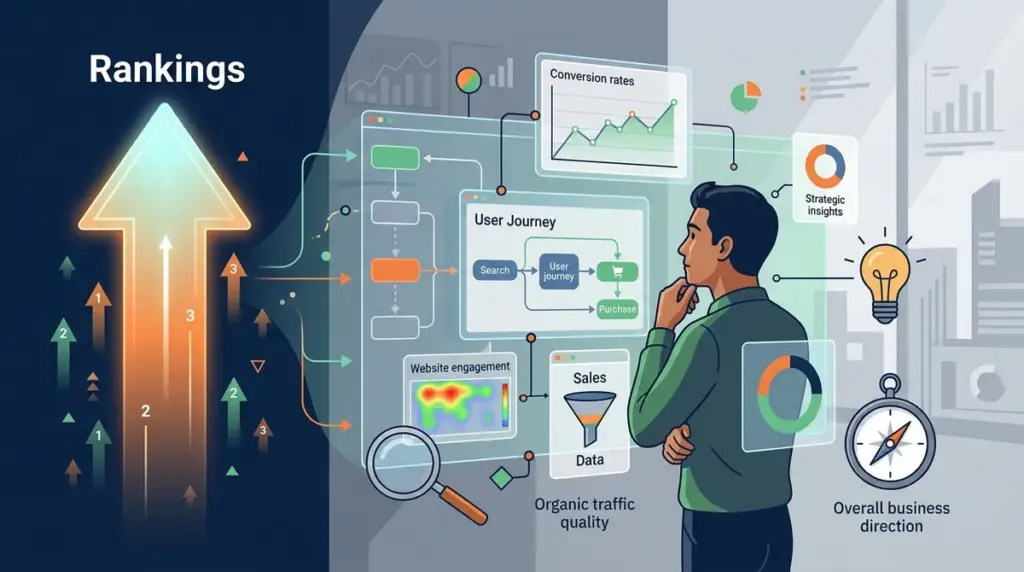
To move beyond vanity metrics, shift your reporting toward KPIs that reflect business health. Instead of leading with "average position," lead with "organic revenue" or "qualified lead volume." This requires integrating your SEO data with a CRM or an e-commerce platform to track the user journey from the initial search to the final transaction.
Start by segmenting your keywords into "Brand," "Product/Service," and "Educational" categories. Monitor the conversion rate for each segment individually. You will likely find that your "Product/Service" keywords have a lower rank but a significantly higher conversion value than your "Educational" keywords. This insight allows you to allocate resources toward the content that actually moves the needle, rather than chasing the ego boost of a #1 spot for a non-converting term.
Frequently Asked Questions
Why is my traffic dropping even though my rankings are stable?
This is often due to changes in the SERP layout. Google may have introduced a new Featured Snippet, an AI Overview, or additional ad units that push organic results further down the page. It can also happen if the total search volume for your target keywords is seasonally declining.
Can a site with lower rankings out-earn a site with higher rankings?
Yes. If the lower-ranking site has better brand recognition, more enticing meta data (like star ratings or price schema), and a landing page optimized for conversions, it will generate more revenue than a higher-ranking site that lacks these elements.
How do I know if I’m targeting the wrong keywords?
Look at your bounce rate and conversion rate for specific landing pages. If a page ranks well but has a high bounce rate and zero conversions, there is a mismatch between what the user expects to find and what you are providing. This suggests the keyword intent is not aligned with your business goal.
Should I stop tracking rankings entirely?
No. Rankings are a vital diagnostic tool. They tell you if your technical SEO and content strategy are working. However, they should be treated as a leading indicator of visibility, not a final measure of success. Always pair ranking data with traffic and conversion data to get the full picture.