Local citations are the foundational data points that confirm a business's physical existence and location to search engines. For any business operating out of a storefront or serving a specific geographic area, these mentions act as digital votes of confidence. When Google’s algorithm attempts to determine which businesses to display in the "Map Pack" or local search results, it cross-references data from across the web to verify that a business is legitimate, active, and located where it claims to be. Understanding these foundational elements is a key first step in any comprehensive local SEO checklist.
A citation is any online mention of a business’s Name, Address, and Phone number (often abbreviated as NAP). While a link back to your website is beneficial, a citation does not require a hyperlink to provide SEO value. Its primary function is to establish "Prominence" and "Relevance"—two of the three pillars of local search ranking—by creating a consistent trail of data that search engines can trust.
The Anatomy of Structured and Unstructured Citations
Not all citations carry the same weight or appear in the same format. Understanding the distinction between structured and unstructured data is essential for prioritizing your manual outreach and automated distribution efforts.
Structured Citations
These are the most common forms of citations found on business listing sites and directories. The data is presented in a standardized format, making it easy for search engine crawlers to parse. Examples include:
- General Business Directories: Platforms like Yelp, Yellow Pages, and Bing Places.
- Industry-Specific Directories: Sites like TripAdvisor for hospitality, Houzz for home contractors, or Healthgrades for medical professionals.
- Social Media Profiles: Business pages on Facebook, LinkedIn, and Instagram that include specific contact fields.
Unstructured Citations
An unstructured citation occurs when business information appears in a non-directory format. These are often more difficult to obtain but carry significant weight because they usually imply a level of editorial endorsement. Examples include:
- Local News and Blogs: A mention in a digital newspaper article about local commerce or a neighborhood blog post.
- Event Listings: Mentions in community calendars or event press releases.
- Government or Educational Sites: Listings on a Chamber of Commerce site or a local university’s "recommended vendors" page.
The Mechanics of NAP Consistency
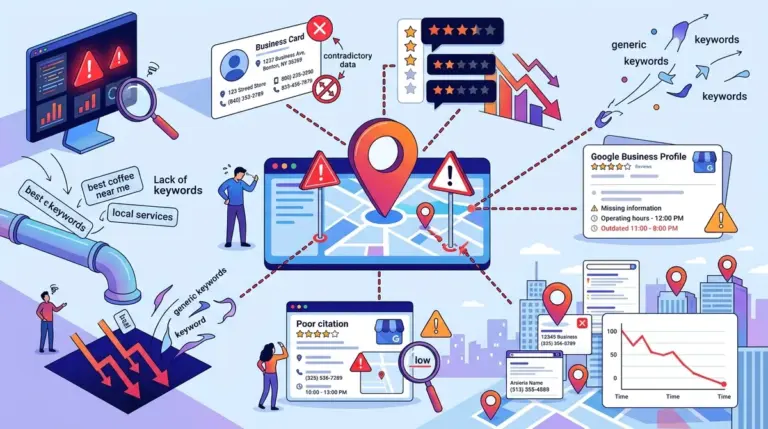
The value of a citation is directly tied to its accuracy. Search engines are essentially large-scale data verification machines. If your business is listed as "Main Street Bakery" on Yelp but "Main St. Bakery, LLC" on Google Business Profile, or if your phone number varies across different directories, it creates "entity ambiguity."
When Google encounters conflicting data, its confidence in your business's location drops. This lack of confidence often results in lower rankings in the local Map Pack. Precision is mandatory. This includes standardized formatting for suite numbers (e.g., using "Ste 200" consistently rather than "Suite 200" in some places and "#200" in others) and ensuring the phone number listed is a local line rather than a generic toll-free number whenever possible.
Warning: Avoid using call tracking numbers for your core citations. While they provide great marketing data, using different numbers across the web will fracture your NAP consistency and significantly damage your local search visibility. Always use your primary local business number for directory listings.
How Citations Influence Local Ranking Factors
Google uses three primary lenses to evaluate local search results: Proximity, Relevance, and Prominence. Citations primarily influence the latter two.
Relevance: By appearing in niche-specific directories (such as a directory for "Austin Plumbers"), you signal to Google exactly what your business does. This helps the search engine categorize your business correctly, ensuring you appear for specific service-based queries rather than just general terms.
Prominence: This is a measure of how well-known a business is. Google looks at information from across the web, including links, articles, and directories. A high volume of consistent citations from authoritative sources tells the algorithm that your business is a staple of the local community. It acts as a digital footprint that proves you are an established entity with a physical presence.
The Role of Data Aggregators in the Ecosystem
You do not have to manually submit your business to every one of the thousands of directories online. The local search ecosystem relies on a few core "Data Aggregators." These are massive databases that collect business information and lease it to smaller directories, GPS services, and search engines.
Key Aggregators include:
- Data Axle (formerly Infogroup): Supplies data to various search engines and in-car navigation systems.
- Foursquare: Powers location data for thousands of apps and social platforms.
- Neustar Localeze: A primary source for local search platforms and mobile apps.
By ensuring your data is correct with these primary aggregators, you create a "trickle-down" effect where your corrected information eventually populates hundreds of smaller, third-tier sites automatically.
Auditing and Cleaning Your Citation Profile
For established businesses, the challenge is rarely "getting more" citations; it is usually cleaning up the mess left by previous marketing agencies, address changes, or business name rebrands. A citation audit is the first step in any local SEO campaign.
Step 1: Identify Inconsistencies. Use search operators to find old versions of your business name or address. Search for your phone number to see where it appears and if it’s attached to an old location.
Step 2: Claim Your Listings. Many directories allow you to "Claim this business." This gives you control over the data and prevents third parties from suggesting incorrect edits.
Step 3: Remove Duplicates. Having two listings on the same platform (like Yelp) is often worse than having none. It splits your "review juice" and confuses search engines. Contact the support teams of these platforms to merge or delete duplicate entries.
Executing a Local Citation Strategy
To move the needle on local rankings, follow a tiered approach to citation building. Start with the "Big Three": Google Business Profile, Bing Places, and Apple Business Connect. These are the direct sources for the most used map applications.
Next, move to the major data aggregators mentioned above to build a broad foundation. Once the foundation is set, focus on "hyper-local" and "hyper-niche" citations. A mention on a local neighborhood association website or a specialized trade directory often carries more weight for ranking than a generic listing on a global directory because the relevance is much higher.
Best for: Businesses in competitive markets where the top three Map Pack spots are contested by multiple established players. In these scenarios, the quality and niche-relevance of your unstructured citations often become the tie-breaker for Google’s algorithm.
Local Citation FAQ
How long does it take for new citations to affect my rankings?
Citations are not an overnight fix. It typically takes between 2 to 4 months for search engines to crawl new listings and for data aggregators to push updates through the ecosystem. Consistency is a long-term trust signal.
Do I need to pay for premium directory listings?
In most cases, no. While some directories offer "featured" spots for a fee, the SEO value of the citation itself is usually the same whether you pay or use the free version. Only pay if the directory actually drives direct referral traffic to your site.
What happens if my business moves to a new address?
You must perform a full citation cleanup. Update your Google Business Profile first, then move to the major data aggregators. It is critical to find and update old listings rather than just creating new ones, as overlapping addresses will cause ranking suppression.
Are social media profiles considered citations?
Yes. Profiles on platforms like Facebook and LinkedIn are considered structured citations because they contain specific NAP fields that search engines can easily verify against your other listings.