Local SEO is the process of optimizing your online presence to attract more business from relevant local searches. Unlike traditional SEO, which focuses on global or national visibility, local SEO targets the "Map Pack" and localized organic results. For a business with a physical storefront or a defined service area, failing to optimize for local intent means ceding high-value, high-intent leads to competitors who are often only a few blocks away. This checklist provides the technical and content requirements necessary to establish a foothold in local search results.
Claiming and Optimizing Your Google Business Profile
Your Google Business Profile (GBP) is the single most influential factor in local search rankings. It acts as a digital storefront that feeds data directly into Google Maps and the local search ecosystem. A verified profile is not enough; it must be exhaustive and active.
Primary Actions:
- Select the correct primary category: Google uses this to determine which searches your business is relevant to. If you are a "Family Law Attorney," do not simply select "Lawyer." Specificity reduces competition with irrelevant service providers.
- Write a keyword-rich description: Avoid marketing fluff. State exactly what you do, where you do it, and what unique services you offer. Use 750 characters to provide context to Google’s NLP (Natural Language Processing) algorithms.
- Upload high-resolution photos: Businesses with interior, exterior, and team photos see higher click-through rates. Google tracks user engagement with these images as a proxy for business legitimacy.
- Utilize Google Posts: Treat this like a social feed. Frequent updates about offers, events, or news signal to Google that the business is operational and engaged with its community.
Warning: Never use a P.O. Box or a virtual office address for your Google Business Profile. Google’s guidelines strictly require a physical location where customers can be met, or a designated service area for mobile businesses. Using a virtual office can lead to immediate profile suspension and the loss of all accumulated reviews.
Ensuring NAP Consistency Across the Web
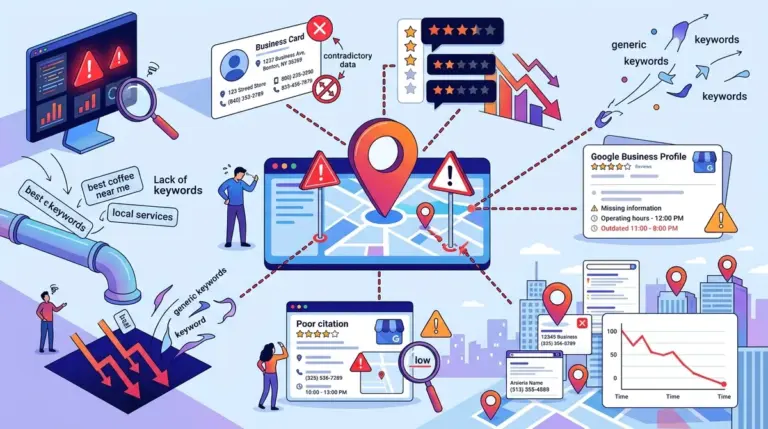
NAP stands for Name, Address, and Phone number. Search engines use these three data points to verify that your business is a legitimate entity. Inconsistency—such as "Street" vs. "St." or a different phone number on a directory—creates "data noise," which can dilute your local authority.
Best for: Establishing trust with search engine crawlers and preventing customer confusion.
Start by auditing your existing mentions. Ensure that your NAP on your website's footer matches your GBP exactly. Then, extend this consistency to major aggregators and directories like Yelp, Bing Places, Apple Maps, and the Yellow Pages. If your business moves or changes phone numbers, updating these citations must be your first priority to prevent a drop in rankings.
Structuring Location Pages for Local Intent
If your business operates in multiple cities or neighborhoods, you need dedicated location pages. A single "Contact Us" page is insufficient for ranking in multiple geographic areas. Each page should be a unique landing zone tailored to the specific community it serves.
Technical Requirements for Location Pages
Each location page should include a Google Maps embed of your specific GBP location. This creates a direct link between your website content and your map listing. Furthermore, you must implement LocalBusiness Schema markup. This is a snippet of JSON-LD code that tells search engines exactly what your business is, your hours of operation, and your price range in a language they can parse without ambiguity.
Content Requirements for Location Pages
Avoid "cookie-cutter" content where only the city name is swapped. To rank, these pages need local relevance. Include mentions of nearby landmarks, local news, or specific services offered at that branch. If you are a contractor, list specific projects completed in that neighborhood to demonstrate local expertise.
Managing Review Velocity and Response Rates
Reviews are not just social proof; they are a direct ranking factor. Google looks at the quantity, the average rating, and the "velocity"—how frequently new reviews are posted. A business with 500 reviews from three years ago is less relevant than a business with 50 reviews, five of which were posted this month.
Pro Tip: When responding to reviews, naturally incorporate service and location keywords. If a customer praises your "emergency plumbing repair in Phoenix," your response should acknowledge those specific terms. This adds semantic depth to your profile.
Develop a system for requesting reviews at the point of sale or via follow-up emails. High-star ratings are important, but responding to negative reviews is equally critical. A professional response to a complaint demonstrates business maturity and can often mitigate the damage to your conversion rate.
Localized Keyword Research and On-Page SEO
Traditional keyword research identifies what people are searching for; local keyword research identifies how they search for it in your specific area. This often involves "geo-modifiers."
Instead of targeting "HVAC repair," a local business should target:
- HVAC repair in [City Name]
- AC installation near me
- Best furnace technicians [Neighborhood Name]
- Emergency cooling services [Zip Code]
Place these geo-modified keywords in your H1 tags, meta descriptions, and alt text for images. However, avoid over-optimization. If the text feels forced or repetitive to a human reader, it is likely over-optimized for search engines, which can lead to a "keyword stuffing" penalty.
Building Local Backlinks and Citations
In local SEO, a link from a local high school, a neighborhood blog, or a local chamber of commerce is often more valuable than a link from a high-authority national site. These "hyper-local" links signal to Google that you are a prominent member of the local economy.
Consider sponsoring local events or charities. These often result in a backlink from the organization’s "Sponsors" page. Additionally, look for industry-specific directories. If you are a locksmith, being listed on a national directory of certified locksmiths provides a niche-relevant citation that bolsters your topical authority.
Executing Your Local Search Strategy
Local SEO is a long-term play that requires consistent maintenance. Start by securing your Google Business Profile and ensuring your NAP data is uniform across the web. Once the foundation is set, focus on generating a steady stream of reviews and building out location-specific content that serves your audience's immediate needs. Monitor your performance through Google Search Console, paying close attention to "Map" queries vs. "Web" queries. By focusing on geographic relevance rather than just raw traffic, you ensure that the visitors you attract are the ones most likely to convert into physical customers. Once the foundation is set, focus on generating a steady stream of reviews and building out location-specific content that serves your audience's immediate needs.
Frequently Asked Questions
How long does it take to see results from Local SEO?
While some changes, like optimizing a Google Business Profile, can show impact within weeks, a full local strategy typically takes 3 to 6 months to mature. This timeline depends on the competitiveness of your industry and the current strength of your citations.
Do I need a physical office to rank in Local SEO?
You do not necessarily need a storefront where customers visit, but you do need a physical address for verification. "Service Area Businesses" (like plumbers or cleaners) can hide their address on Google and instead define a radius or list of cities they serve.
Does social media impact local rankings?
Social media profiles often appear in local search results and provide additional citations for your NAP data. While "likes" are not a direct ranking factor, the traffic and brand signals generated by social media can indirectly support your local authority.
What is the difference between a citation and a backlink?
A citation is any mention of your business’s NAP data online, even without a link. A backlink is a clickable link from another website to yours. Both are essential, but citations are more specific to local identity verification.