On-page SEO is the practice of optimizing individual web pages to rank higher and earn more relevant traffic in search engines. Unlike off-page SEO, which relies on external signals like backlinks and social mentions, on-page SEO is the single area of digital marketing where you have total control. If your page does not clearly communicate its purpose to a crawler through its content and HTML structure, no amount of external promotion will secure a sustainable top-three position. This guide breaks down the specific mechanics of page-level optimization to ensure your site meets both user intent and algorithmic requirements. Understanding the on page seo basics is the first step to improving your site's visibility.
The Core Pillars of Page-Level Optimization
Effective on-page SEO is no longer about repeating a keyword a specific number of times. Modern search engines use Natural Language Processing (NLP) to understand the context, depth, and utility of a page. To satisfy these systems, you must address three distinct layers: the content layer, the HTML layer, and the site architecture layer.
Best for: Marketing managers and site owners who need to audit existing content or brief writers on new landing pages.
Title Tags and Header Hierarchy
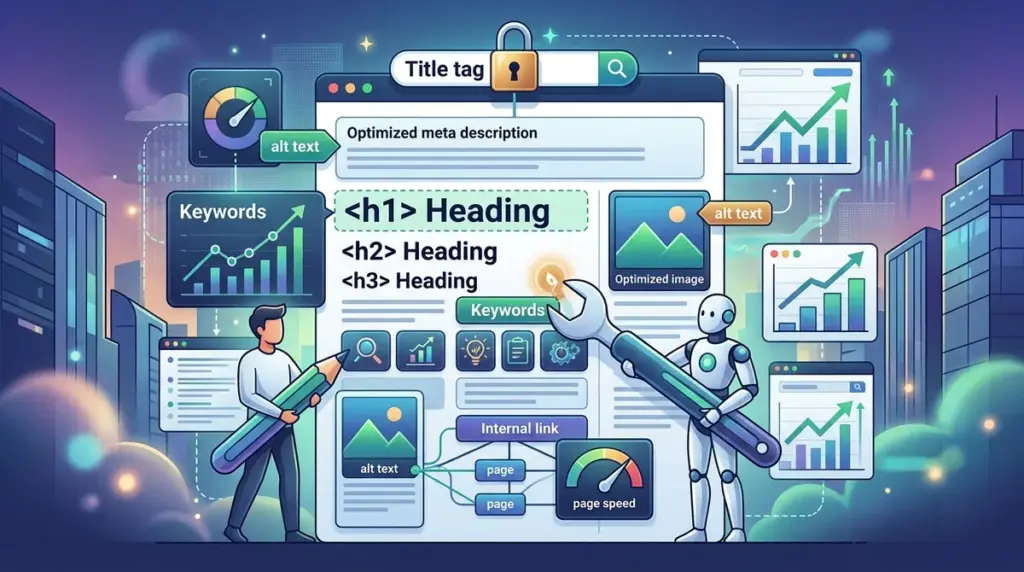
The title tag remains the most significant on-page element. It functions as the "headline" in search engine results pages (SERPs). To maximize its effectiveness, place your primary keyword toward the beginning of the tag. Search engines give more weight to the first few words, and users scanning results are more likely to click when they see their search term immediately. Keep these under 60 characters to avoid truncation.
Header tags (H2, H3, H4) are not just for styling; they provide a roadmap for crawlers. An H2 should represent a sub-topic of the main H1. If your H1 is "How to Bake Sourdough Bread," your H2s should be "Essential Ingredients," "The Fermentation Process," and "Baking Temperatures." This hierarchy allows Google to understand the breadth of your coverage on a specific topic.
Meta Descriptions as Conversion Drivers
While meta descriptions are not a direct ranking factor, they are a critical click-through rate (CTR) factor. A well-written description acts as free ad copy. It should summarize the page content in 155–160 characters and include a clear call to action (CTA) like "Learn more," "Download the guide," or "Get a free quote." A higher CTR signals to search engines that your result is relevant to the query, which can indirectly improve your rankings over time.
Aligning Content with Search Intent
The most common reason high-quality content fails to rank is a mismatch in search intent. Search intent is the "why" behind a user's query. If a user searches for "best CRM software," they are looking for a comparison list (commercial investigation), not a product landing page for a specific CRM (transactional). If you try to rank a product page for a comparison query, you are fighting the algorithm's understanding of what the user actually wants.
Types of Search Intent:
- Informational: The user wants an answer to a question (e.g., "What is on-page SEO?").
- Navigational: The user wants to find a specific website or page (e.g., "SEO Learning Center login").
- Commercial: The user is researching products but isn't ready to buy (e.g., "best SEO tools for small business").
- Transactional: The user is ready to make a purchase (e.g., "buy SEO audit template").
Pro Tip: Before writing a single word, search for your target keyword in an incognito window. Look at the top three results. Are they long-form guides, videos, or product listings? Your content format must match the dominant format in the SERP to have a realistic chance of ranking.
URL Structure and Internal Linking
A clean URL structure helps both users and search engines understand where they are on your site. Avoid long, cryptic URLs filled with numbers or session IDs. Instead, use a descriptive "slug" that includes your primary keyword. For example, SEO Learning Center/blog/on-page-seo-guide is significantly more effective than SEO Learning Center/p=12345.
Internal linking is the process of linking to other pages on your own website. This serves two purposes: it helps users navigate your site, and it distributes "link equity" (ranking power) throughout your pages. When you link from a high-authority page (like your homepage) to a new blog post, you are signaling to Google that the new post is important. Use descriptive anchor text that tells the reader exactly what they will find on the next page.
Image Optimization and Accessibility
Images make content more engaging, but they can also slow down your site if not handled correctly. Every image on your page should have descriptive "alt text." This is a short sentence describing the image for visually impaired users using screen readers. It also helps search engines index the image for Image Search. Furthermore, ensure your images are compressed to keep page load times low, as mobile-first indexing prioritizes fast-loading pages.
The Mechanics of Semantic Keywords
Modern SEO relies on "entities" and "LSI" (Latent Semantic Indexing) keywords. These are terms and phrases closely related to your main topic. For a page about "On-Page SEO," semantic keywords might include "search engine results," "HTML tags," "user experience," and "crawling." Including these terms naturally throughout your content proves to the search engine that you are covering the topic comprehensively rather than just repeating a single keyword. This builds topical authority, which is essential for ranking in competitive niches.
An Actionable On-Page SEO Checklist
To ensure consistency across your site, follow this workflow for every new page you publish. This process moves from the high-level intent down to the technical details that differentiate a ranking page from a buried one.
1. Verify the Intent: Does the page format (listicle, guide, product page) match the current top-ranking results for the target keyword?
2. Optimize the H1: Ensure there is only one H1 per page and that it contains your primary keyword.
3. Audit the Headers: Use H2s and H3s to break up the text and include secondary keywords or related questions.
4. Check Image Alt Text: Every image should have a descriptive tag that includes a keyword only where it is contextually relevant.
5. Set the URL Slug: Keep it short, lowercase, and descriptive.
6. Add Internal Links: Link to at least 2-3 other relevant pages on your site, and ensure 2-3 existing pages link back to the new content.
7. Review Mobile Usability: Open the page on a mobile device to ensure text is readable and buttons are clickable without zooming.
Common Questions About On-Page SEO
How long should my content be to rank?
There is no "magic" word count. Content should be as long as necessary to fully answer the user's query. A simple "how-to" might only need 500 words, while a definitive guide to a complex topic might require 3,000. Focus on "information density" rather than word count.
Does keyword density still matter?
No. The concept of maintaining a specific percentage of keywords (e.g., 2%) is outdated. Instead, focus on using your keyword in the title, the first paragraph, and naturally throughout the text where it makes sense for the reader.
How often should I update my on-page SEO?
You should review your top-performing pages at least once every six months. Search intent can shift, and competitors may release more up-to-date information. Refreshing your statistics, internal links, and meta descriptions can often lead to a quick boost in rankings.
Is on-page SEO more important than backlinks?
They serve different purposes. On-page SEO tells search engines what your page is about; backlinks tell them how much people trust your page. You cannot rank for a specific term without on-page optimization, but you often cannot rank for highly competitive terms without backlinks.