On-page SEO is the process of optimizing individual web pages to rank higher and earn more relevant traffic in search engines. Unlike off-page SEO, which relies on external signals like backlinks, on-page factors are entirely within your control. For a beginner, the goal is to align your content with search intent while providing clear signals to search engine crawlers about the page's purpose. Neglecting these basics means even high-quality content can remain invisible to your target audience. Understanding the fundamentals of what on page SEO is will set you up for success.
Title Tags and the First Impression
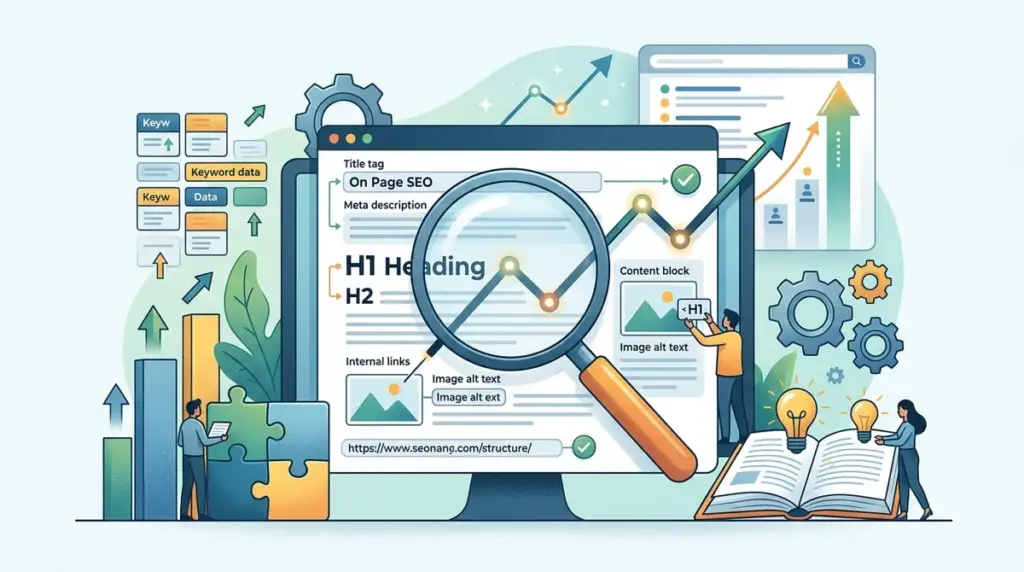
The title tag is the most significant on-page SEO element. It appears as the clickable headline in search engine results pages (SERPs) and in the browser tab. Google typically displays the first 50 to 60 characters of a title tag; exceeding this limit often results in truncation, which can obscure your value proposition.
Best for: Establishing immediate relevance and improving Click-Through Rate (CTR).
- Place your primary keyword near the beginning of the title to give it more weight.
- Use unique titles for every page to avoid internal competition.
- Include your brand name at the end of the title, separated by a pipe (|) or dash (-).
Meta Descriptions as Sales Copy
While meta descriptions are not a direct ranking factor, they function as your organic ad copy. A well-written description summarizes the page content and encourages users to click. Keep these under 155 characters to ensure they display correctly across mobile and desktop devices. If you leave this blank, Google will pull a random snippet of text from your page, which often lacks a clear call to action.
Logical Header Hierarchy
Search engines use headers (H1, H2, H3, etc.) to understand the structure and hierarchy of your content. A page should feature only one H1 tag, which serves as the main title of the article or page. Subsequent H2 tags should break the content into major sections, while H3 tags provide sub-points within those sections.
This structure serves two purposes: it allows crawlers to parse the relationship between different topics on the page, and it makes the content scannable for readers who rarely read every word. Use your primary and secondary keywords naturally within these headers to reinforce the page's topical authority.
Pro Tip: Avoid using headers for styling elements like "Contact Us" buttons or sidebar widgets. Headers are semantic markers for content, not design tools. Misusing them confuses search engines regarding the primary topic of the page.
URL Structure and Clean Permalinks
A URL should be descriptive and easy to read for both humans and bots. Avoid long strings of numbers, dates, or dynamic parameters. A clean URL like SEO Learning Center/on-page-seo-basics is far more effective than SEO Learning Center/p=123?category=seo. Short URLs tend to perform better in search results and are more likely to be shared on social media. Always use hyphens to separate words, as underscores are not recognized as word separators by most search engines.
Content Optimization and Keyword Intent
Modern SEO has shifted from "keyword frequency" to "topical relevance." Google’s algorithms, such as RankBrain and BERT, are designed to understand the intent behind a search query. To optimize content effectively, you must identify whether the user is looking for information (informational), a specific website (navigational), or to make a purchase (transactional).
Best for: Reducing bounce rates and increasing time-on-page metrics.
Focus on "Semantic SEO" by including related terms and synonyms that naturally occur within a deep dive into a topic. For example, if you are writing about "On-Page SEO," you should naturally mention "alt text," "internal links," and "site speed." If these related terms are missing, search engines may view your content as thin or incomplete. To further enrich your content and improve site navigation, consider exploring internal linking strategies.
Image Optimization and Accessibility
Images add visual value but can also slow down your site if not managed correctly. Large image files are a primary cause of high page load times, which is a confirmed ranking factor. Use modern formats like WebP and compress images before uploading them. Beyond speed, every image must have descriptive Alt Text. This text helps visually impaired users through screen readers and provides context to search engines that cannot "see" the image content. If an image fails to load, the Alt Text appears in its place.
Internal Linking Strategy
Internal links connect one page of your website to another. They distribute "link equity" (ranking power) throughout your site and help Google discover new pages. When linking internally, use descriptive anchor text that tells the user exactly what they will find on the next page. Avoid generic phrases like "click here" or "read more." Instead, use phrases like "guide to keyword research" to provide context to the destination page.
Mobile Responsiveness and Performance
Google uses mobile-first indexing, meaning it primarily uses the mobile version of a site for indexing and ranking. If your site is difficult to navigate on a smartphone, your rankings will suffer regardless of how good your content is. Ensure your site uses a responsive design that adjusts to any screen size. Additionally, monitor your Core Web Vitals—specifically Largest Contentful Paint (LCP), First Input Delay (FID), and Cumulative Layout Shift (CLS)—to ensure the page is stable and interactive within seconds of a user clicking your link.
Implementing Your On-Page Audit
To begin improving your site, start with your highest-traffic pages. Use a crawler to identify missing title tags, duplicate meta descriptions, and broken internal links. Once the technical errors are cleared, move into content refinement. Update old statistics, add internal links to newer posts, and ensure your H2 and H3 tags follow a logical flow. On-page SEO is not a one-time task; it requires periodic reviews to ensure your content remains accurate and competitive as search trends evolve.
Frequently Asked Questions
How long does it take for on-page SEO changes to work?
Changes can be reflected in search results as soon as Google re-crawls your page, which typically takes anywhere from a few days to a few weeks. You can speed up this process by requesting a crawl through Google Search Console.
Does keyword density still matter for ranking?
No, specific keyword density percentages are an outdated concept. Focus on natural language and covering a topic comprehensively. If you write naturally about a subject, your keywords will naturally appear at an appropriate frequency.
Should I optimize for every single keyword I find?
No. You should optimize each page for one primary keyword and a handful of closely related secondary keywords. Trying to rank one page for dozens of unrelated terms confuses the search engine and often results in the page ranking for nothing at all.
Is Alt Text only for SEO?
No, Alt Text is primarily an accessibility feature for users with visual impairments. However, because it provides context to search engines, it serves a dual purpose as a powerful SEO signal for image search and overall page relevance.