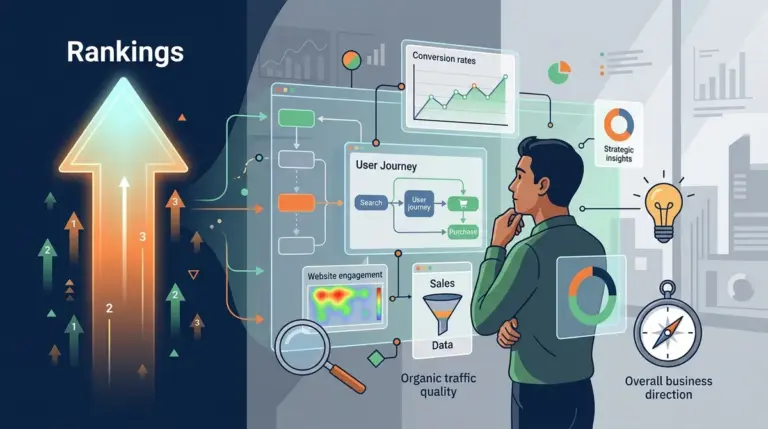

Organic click-through rate (CTR) is the percentage of searchers who see a specific search engine result and choose to click it. In the context of SEO, this metric serves as the bridge between raw visibility and actual website traffic. Ranking on the first page of Google is a prerequisite for success, but if your listing fails to earn the click, that ranking provides zero commercial value. For SEO professionals, CTR is the primary lever for increasing traffic without needing to move up a single rank position.
The Mathematical Foundation of CTR
Calculating CTR is a straightforward division of two core metrics found in Google Search Console: clicks and impressions. If a page appears in the search results 1,000 times (impressions) and receives 50 clicks, the CTR is 5%.
Best for: Benchmarking the effectiveness of your SERP (Search Engine Results Page) snippets across different device types and geographic locations.
While the formula is simple, the interpretation is complex. A 5% CTR might be exceptional for a highly competitive commercial keyword where the SERP is crowded with four ads, a map pack, and a "People Also Ask" section. Conversely, a 5% CTR for a branded search term—where a user is specifically looking for your company—would be considered a significant failure in snippet optimization.
The CTR Decay Curve and Position Value
The relationship between search position and click-through rate is non-linear. Data consistently shows a "decay curve" where the drop-off in clicks between position one and position ten is massive. Typically, the first organic result captures between 25% and 35% of all clicks. By the time a user reaches position five, the expected CTR often drops below 5%. Results on the second page of Google rarely see a CTR above 0.5%.
Understanding this curve is vital for resource allocation. Moving a keyword from position 12 to position 8 provides a negligible traffic increase. However, moving a high-volume keyword from position 3 to position 1 can triple your traffic overnight. SEOs use this data to prioritize "striking distance" keywords—those ranking in positions 2 through 5—where a small ranking gain or a snippet improvement yields the highest ROI.
Pro Tip: Do not compare your CTR against global averages. Instead, segment your data by intent. Informational queries ("how to bake bread") naturally have lower CTRs due to featured snippets providing immediate answers, while navigational queries ("gmail login") have extremely high CTRs for the top result.
Anatomy of a High-Performance Search Snippet
To influence CTR, you must optimize the elements that appear on the SERP. These are your only tools for persuading a user to choose your link over nine others.
- Title Tags: This is your primary headline. Effective titles often include the primary keyword near the beginning, use "power words" (e.g., "Proven," "Step-by-Step," "Complete Guide"), and address the user's specific pain point.
- Meta Descriptions: While not a direct ranking factor, the meta description acts as your "ad copy." It should expand on the title, provide a clear call to action (CTA), and include secondary keywords that Google may bold if they match the user's query.
- URL Structure: A clean, descriptive URL (slug) builds trust. Users are more likely to click
SEO Learning Center/best-running-shoesthanSEO Learning Center/p=12345. - Rich Snippets: By implementing Schema markup (Structured Data), you can earn "rich" elements like star ratings, product prices, recipe cooking times, or FAQ dropdowns. These visual additions increase the "real estate" your result occupies, naturally drawing the eye and boosting CTR.
The Impact of SERP Features and Zero-Click Searches
Modern SEO is no longer a simple list of ten blue links. Google has introduced various features that can either assist or cannibalize your CTR. The most significant of these is the "Zero-Click Search," where the user's query is answered directly on the search page via a Featured Snippet or Knowledge Panel.
If you rank in position one but Google displays a Featured Snippet from a competitor above you, your CTR will plummet. Conversely, winning the Featured Snippet (often called "Position Zero") can skyrocket your traffic, though it may also lead to a higher percentage of users who read the snippet and leave without clicking. You must decide if the brand impressions and authority gained from a Featured Snippet outweigh the potential loss in site visits.
Is CTR a Ranking Factor?
There is a long-standing debate in the SEO community regarding whether Google uses CTR as a direct ranking signal. While Google’s official stance has often been vague or dismissive, leaked documentation and various patents suggest that user interaction signals—including clicks—are used to evaluate the relevance and quality of search results.
If a page in position four consistently receives more clicks than the page in position two, it sends a strong signal to the algorithm that the fourth result is more relevant to the user's intent. Over time, the algorithm is likely to adjust the rankings to reflect this user preference. Regardless of whether it is a "weighted" ranking factor, improving CTR is a win-win: it increases traffic immediately and likely strengthens your long-term ranking stability.
Executing a Systematic CTR Audit
To improve your CTR, you need a data-driven workflow rather than a series of guesses. Start by exporting your performance data from Google Search Console. Filter for keywords where your "Average Position" is high (Top 5) but your "CTR" is below the expected average for that position.
Once identified, analyze the SERP for those keywords. Are your competitors using more compelling titles? Do they have review stars or FAQ schema that you lack? Test new title tag variations by changing the framing—for example, switching from a "How-To" angle to a "Listicle" angle. Monitor the results over 14 to 30 days. If the CTR improves, roll those changes out to similar pages across your site. This iterative testing process ensures that your organic presence is always optimized for the human user, not just the search crawler.
CTR Frequently Asked Questions
What is a "good" organic click-through rate?
A "good" CTR is relative to your position and intent. Generally, a position one result should aim for 20% or higher. For positions three to five, 5% to 10% is considered healthy. For branded terms, you should expect 50% or more.
Can high CTR lead to higher bounce rates?
Yes, if your snippet makes promises that the content doesn't keep (clickbait). If you trick a user into clicking with a misleading title, they will bounce immediately, which signals to Google that your page did not satisfy the search intent.
How long does it take for CTR changes to show in Search Console?
Google usually updates Search Console data within 24 to 48 hours. However, to see a statistically significant change in your average CTR after updating a title or meta description, you should wait at least two weeks to account for daily fluctuations in search behavior.