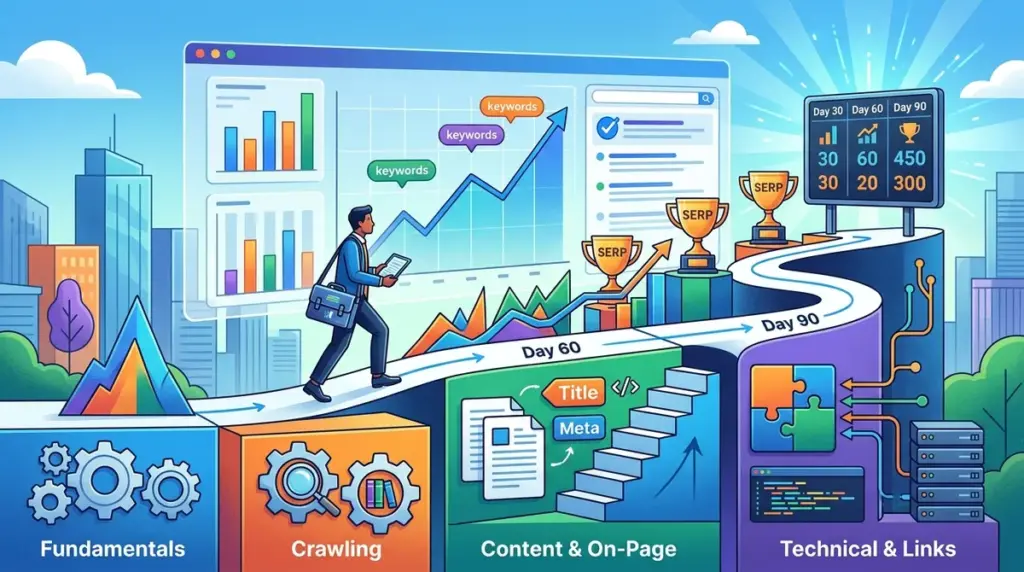
Mastering SEO in 90 days requires moving past surface-level definitions to understand the feedback loop between search engine crawlers and user behavior. Most beginners fail because they treat SEO as a checklist of "hacks" rather than a systematic process of improving site accessibility and relevance. This roadmap transitions from foundational mechanics to technical execution and performance analysis, providing a structured path for marketers and site owners to build a functional skill set.
Month 1: Decoding Search Engine Mechanics
The first 30 days are dedicated to understanding how Google discovers, parses, and stores information. Without this context, technical fixes are just guesswork.
The Crawl-Index-Rank Pipeline
Focus: Search engine architecture.
You must learn to differentiate between a page being "live" and a page being "indexed." Use the first week to study how Googlebot utilizes the crawl budget—the number of pages a bot decides to crawl on your site within a given timeframe. High-priority tasks include mastering robots.txt syntax to prevent bots from wasting resources on low-value pages like internal search results or login screens. Use the "URL Inspection" tool in Google Search Console (GSC) to see exactly how Google renders your HTML versus what a user sees.
Search Intent and Keyword Mapping
Focus: Moving beyond volume metrics.
Keyword research is often taught as a hunt for high-volume terms, but commercial success depends on intent mapping. Spend week three categorizing keywords into four buckets: Informational (how-to), Navigational (brand names), Commercial (best products), and Transactional (buy now).
- Informational: Targets users at the top of the funnel looking for education.
- Commercial: Targets users comparing solutions before a purchase.
- Transactional: Targets users ready to convert immediately.
By the end of the first month, you should be able to look at a Search Engine Results Page (SERP) and identify which content format—be it a listicle, a product page, or a video—is required to rank for a specific query.
Month 2: Technical Audits and On-Page Optimization
The second month shifts from theory to implementation. This is where you learn to identify the friction points that prevent a site from ranking despite having good content.
The Technical Foundation
Focus: Site health and Core Web Vitals.
Learn to run a site crawl using industry-standard tools like Screaming Frog. You are looking for broken links (404 errors), unnecessary redirects (301 chains), and duplicate content caused by URL parameters. This is also the time to study Core Web Vitals (CWV), specifically Largest Contentful Paint (LCP) and Cumulative Layout Shift (CLS). These aren't just "speed" metrics; they are stability metrics that impact how a user interacts with your page. A site that jumps around while loading will suffer in rankings because it provides a poor user experience.
Warning: Never implement a site-wide redirect or change your URL structure without first mapping out a 1:1 redirect plan. Failing to account for legacy URLs is the fastest way to lose years of accumulated "link equity" and tank your traffic overnight.
On-Page Content Engineering
Focus: Entities, headers, and metadata.
On-page SEO is no longer about "keyword density." It is about entity salience—how well your content covers the subtopics related to your main subject. Learn to use H2 and H3 tags to create a logical hierarchy that helps both users and bots skim the page. Practice writing meta descriptions that function as "ad copy" to improve Click-Through Rate (CTR), and ensure every image has descriptive Alt Text to assist with accessibility and image search visibility.
Month 3: Authority Building and Data Analysis
The final 30 days focus on external signals and the math behind the rankings. This is where you prove that your efforts are generating a return on investment.
Off-Page Strategy and Link Ethics
Focus: E-E-A-T and backlink profiles.
Search engines use backlinks as votes of confidence. However, not all votes are equal. Spend this month learning to evaluate the quality of a referring domain. A single link from a high-authority, niche-relevant publication is worth more than a thousand links from generic "link farms." Focus on "Experience, Expertise, Authoritativeness, and Trustworthiness" (E-E-A-T). This involves ensuring your content is attributed to real authors with verifiable credentials and securing mentions from reputable sources in your industry.
Performance Reporting in GA4 and GSC
Focus: Turning data into actionable insights.
SEO is a long-term game, but you must be able to track incremental progress. Learn to navigate Google Analytics 4 (GA4) to identify which landing pages have the highest engagement rates and which are causing users to drop off. Use Google Search Console to monitor "Impressions" versus "Clicks." If a page has high impressions but low clicks, your title tag or meta description is likely failing to entice the user. If a page has high clicks but a high bounce rate, your content is likely failing to satisfy the user's intent.
Executing Your First Independent Audit
To solidify these 90 days of learning, perform a "Gap Analysis" on a live website. Identify keywords your competitors rank for that you do not, find technical errors in their site structure that you can avoid, and look for "content decay" on your own site—older posts that have lost traffic and need refreshing with updated data and new links. SEO is not a "set and forget" discipline; it is a cycle of auditing, implementing, and measuring. By the end of this 90-day period, you will have moved from a passive observer to a practitioner capable of diagnosing and solving organic growth problems. This process of auditing, implementing, and measuring is key to building your own SEO learning plan and moving beyond passive observation.
Frequently Asked Questions
How much time should I dedicate daily to this plan?
To see meaningful progress, allocate 60 to 90 minutes per day. Use the first 30 minutes for reading/theory and the remaining hour for hands-on practice, such as running audits or writing optimized copy.
Do I need to learn how to code for SEO?
You do not need to be a software engineer, but you should be able to read HTML and CSS. Understanding how a <canonical> tag or a <noindex> tag works in the source code is essential for troubleshooting indexing issues.
What is the most important tool for a beginner?
Google Search Console is the most critical tool. It provides direct feedback from Google about how your site is performing, which pages are indexed, and any manual penalties or security issues affecting your visibility.
When will I start seeing results from my SEO efforts?
SEO typically takes 3 to 6 months to show significant movement in rankings. The 90-day plan focuses on the "input" phase; the "output" in terms of traffic and conversions usually follows once Google has re-crawled and re-evaluated your optimized site.