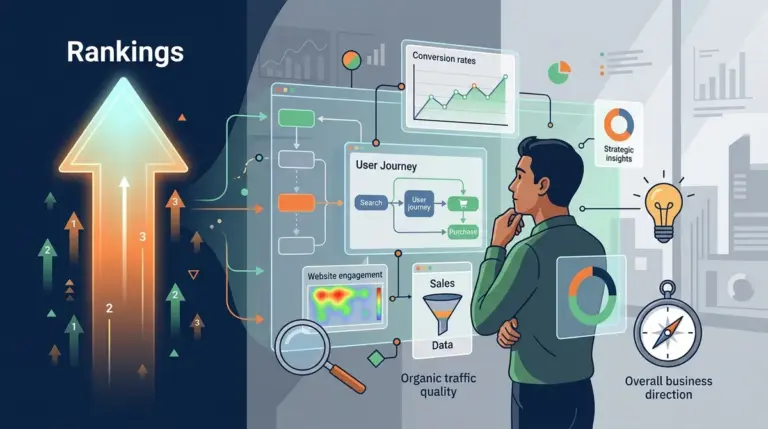

Tracking keyword rankings is often treated as a vanity exercise, yet it remains the most direct diagnostic tool for measuring the health of an SEO strategy. If a page drops from position three to position twelve, it is not just a number change; it is a loss of roughly 70% of that keyword's potential click-through rate. Proper tracking requires moving beyond a single "average position" metric and instead focusing on how specific clusters of keywords respond to technical changes, content updates, and competitor movements. To do this effectively, you must isolate variables like device type, geographic location, and SERP feature volatility. This is why you must understand the difference between rankings vs traffic to truly gauge SEO success.
Establishing a Keyword Segmentation Strategy
Monitoring every keyword your site ranks for is inefficient and creates data noise. High-performance tracking begins with categorization. You should segment your keywords into tiers based on their business value and search intent. This allows you to prioritize high-intent "money" keywords that drive conversions over broad, informational terms that primarily drive top-of-funnel awareness.
Best for: Large e-commerce sites or multi-service agencies that need to report on specific business units independently.
- Brand Keywords: Terms including your company name. These should always rank in position one. Significant fluctuations here often indicate technical indexing issues or aggressive competitor bidding.
- Commercial Intent Keywords: Terms like "best CRM for small business" or "buy organic coffee beans." These are your primary revenue drivers.
- Informational Keywords: "How to" queries and guides. These build authority and feed your retargeting pools.
- Geographic Keywords: Terms appended with a city or "near me" qualifier, essential for local SEO performance.
The Necessity of Local and Device-Level Granularity
Google no longer serves a single "national" search result. Rankings are heavily influenced by the user's IP address and the device they are holding. A site ranking in position two on a desktop in New York may rank in position seven on a mobile device in Chicago due to local pack intrusions or mobile-first indexing differences. To track properly, you must configure your monitoring to reflect your actual customer base.
Mobile tracking is no longer optional. With mobile-first indexing, Google uses the mobile version of your content for ranking and indexing. If your rank tracker only checks desktop results, you are viewing a legacy version of the web that does not align with where 60% or more of your traffic originates. Furthermore, tracking at the ZIP code or city level is vital for service-based businesses where the "Map Pack" dominates the top half of the screen.
Warning: Avoid relying on "Global" or "National" averages for high-competition terms. These metrics often smooth over local volatility, hiding the fact that you might be losing visibility in your most profitable markets.
Monitoring SERP Features and Pixel Height
Traditional "blue link" tracking is becoming obsolete because a "Position 1" ranking does not always mean you are at the top of the page. If a SERP contains a Featured Snippet, a People Also Ask (PAA) block, and a four-ad Google Ads stack, the first organic result might be pushed 1,000 pixels down the page, well below the fold. This is known as "SERP crowding."
Proper tracking must include "Visual Rank" or "Pixel Height." You need to know if you own the Featured Snippet or if you are appearing in the Image Pack. If your rankings are stable but your organic traffic is declining, it is likely that a new SERP feature has pushed your result further down the screen. Tracking these features allows you to pivot your content strategy—for example, by optimizing for a snippet to reclaim that top-of-page real estate.
Differentiating Between Volatility and Algorithmic Shifts
Keyword rankings are not static; they fluctuate daily. This is often referred to as "Google Dance." Checking your rankings every hour will lead to over-optimization and panic. Instead, establish a cadence that matches your reporting needs. For most established sites, a daily check is necessary to spot sudden drops caused by technical errors, while a weekly or monthly roll-up provides the trend data needed for strategic decisions.
When you see a drop, look for patterns across your segments. If only one page dropped, it is likely a content or backlink issue. If an entire category dropped while competitors rose, you are likely looking at a niche-specific algorithmic update. If every page on the site dropped, you are likely facing a site-wide technical penalty or a major core update. Contextualizing these drops against a "SERP Volatility Index" helps determine if the movement is unique to your site or a broader market shift.
Benchmarking Against Specific Competitors
Your rankings do not exist in a vacuum. A drop in your position is often the result of a competitor improving their content or gaining high-authority mentions. Effective tracking includes "Share of Voice" (SoV) metrics. This calculates your visibility across a keyword set compared to your top five or ten competitors.
By tracking competitor rankings alongside your own, you can identify "content gaps." If a competitor suddenly jumps ahead of you for a cluster of terms, analyze their recent updates. Did they add video? Did they improve their page load speed? Tracking competitors allows you to move from reactive SEO to proactive strategy by identifying which tactics are currently being rewarded by the algorithm in your specific vertical.
Operationalizing Your Ranking Data
To turn ranking data into a commercial asset, stop looking at individual keywords and start looking at URL groups. Aggregate the data to see which subfolders (e.g., /blog/ vs. /products/) are gaining or losing ground. This high-level view tells you where to allocate your budget. If your product pages are slipping but your blog is growing, your technical SEO or product descriptions may need an audit. Use your ranking reports to trigger specific actions: a drop below position five should trigger a content refresh, while a move into the top three should trigger an internal linking campaign to solidify that position. Ranking data is only as good as the workflow it informs.
Frequently Asked Questions
Why do my rankings look different in my tracker than they do on my own computer?
This is due to personalization. Google uses your search history, cookies, and physical location to tailor results. Professional tracking tools use "clean" browsers and specific proxies to show an unbiased view of the SERP as a new user would see it.
Should I track keywords with zero search volume?
Yes, if they are highly specific "long-tail" queries. Keyword research tools often underestimate volume for new or niche terms. If a keyword is highly relevant to your product, tracking it can provide early signals of a growing trend before the major tools catch up.
How often should I report on rankings to stakeholders?
While you should monitor data daily or weekly, monthly reporting is usually best for stakeholders. This timeframe is long enough to filter out daily volatility and show meaningful trends resulting from your SEO efforts.
What is the difference between rank and Share of Voice?
Rank is your specific position for one keyword. Share of Voice is a weighted metric that considers your ranking position across a whole group of keywords and the search volume of those terms, providing a percentage-based view of your market dominance.