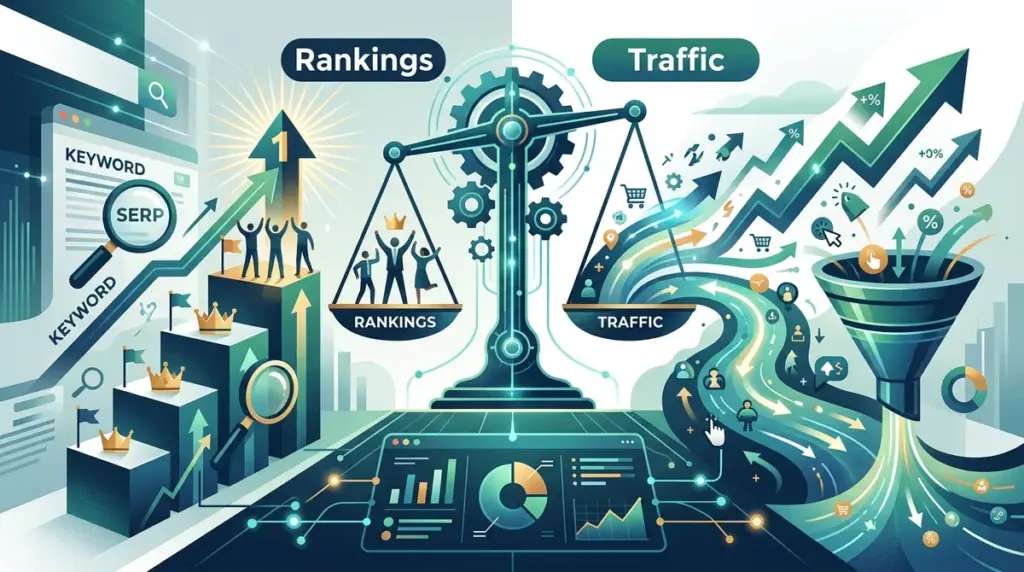
Ranking first for a keyword feels like a definitive win, but if that keyword has a search volume of ten people per month, the business impact is negligible. Conversely, a page sitting at the bottom of page one for a high-intent, high-volume term might drive more revenue than ten top-spot rankings for obscure phrases. The tension between rankings and traffic is the difference between visibility and utility. While rankings measure your standing against competitors, traffic measures your ability to capture actual market interest.
The Mechanics of Search Engine Rankings
Rankings are a primary indicator of SEO health. They tell you where a specific URL sits in the search engine results pages (SERPs) for a given query. Tracking these positions allows you to benchmark your site against industry rivals and understand how Google’s algorithm perceives your content’s relevance and authority.
Best for: Benchmarking brand authority, monitoring technical SEO health, and tracking the immediate impact of on-page optimizations.
High rankings provide a "share of voice" metric. If you occupy the top three spots for a cluster of related terms, you are effectively the dominant player in that niche. However, rankings are increasingly volatile due to personalized search, localized results, and the proliferation of SERP features like AI Overviews and Featured Snippets. A "number one" ranking in a tracking tool might not look the same to a user in New York as it does to one in London.
When Rankings Become a Vanity Metric
Focusing solely on rankings can lead to "ego-tracking." This occurs when an agency or internal team prioritizes ranking for broad, high-volume terms that have no clear path to conversion. For example, ranking #1 for "what is marketing" is prestigious, but for a specialized software company, that traffic is likely too top-of-funnel to result in a sale. The resources spent maintaining that position might be better used capturing lower-volume, "bottom-of-funnel" terms that actually drive leads.
Why Traffic is the Real Currency of SEO
Traffic represents the actual flow of users to your site. Unlike rankings, which are a theoretical potential for visitors, traffic is a concrete measurement of performance. You can have lower rankings but higher traffic if your meta titles and descriptions are optimized for a higher Click-Through Rate (CTR).
Best for: Measuring ROI, understanding user intent, and identifying content gaps that need refreshing.
Traffic data from tools like Google Search Console provides the "ground truth." It reveals which queries are actually bringing people to your pages and how they interact with your snippets. If your traffic is growing while your average position remains static, it usually means you are winning more long-tail queries or that your brand recognition is encouraging users to skip higher-ranked results in favor of yours.
Warning: The Zero-Click Reality
A high ranking no longer guarantees traffic. With the rise of Featured Snippets, Knowledge Panels, and AI-generated answers, many users find the information they need directly on the SERP. You may rank #1 for "current exchange rate" and receive zero clicks because the answer is displayed in a bold box at the top of the page. Always cross-reference your rankings with click data to ensure you aren't fighting for "zero-click" keywords. To avoid this pitfall, you must prioritize tracking keyword rankings accurately and consistently.
Comparing the Two: Where to Allocate Your Budget
The decision to focus on rankings or traffic depends on the maturity of your website and your immediate business goals. A new site needs rankings to establish a baseline of trust with search engines, while an established site should focus on traffic quality to maximize revenue. This is why it's crucial to understand why rankings alone are insufficient for long-term growth.
- Phase 1: Ranking Focus. New domains must prove relevance. Tracking rankings helps you see if Google is "indexing and understanding" your content correctly. If you aren't even in the top 100 for your core terms, traffic isn't a realistic goal yet.
- Phase 2: Traffic Focus. Once you are on pages two or three, the focus shifts to traffic. This involves optimizing for CTR and ensuring the page content matches the user's search intent so they don't bounce immediately.
- Phase 3: Conversion Focus. For mature sites, neither rankings nor traffic is the end goal. The focus shifts to "qualified traffic"—users who are most likely to complete a purchase or sign up for a newsletter.
The Role of Click-Through Rate (CTR)
CTR is the bridge between rankings and traffic. A page ranking at position #4 with an enticing, benefit-driven meta description can often outperform a dry, robotic result at position #2. If your rankings are high but your traffic is low, your first step shouldn't be more backlinks; it should be an audit of your SERP appearance. Testing different title tag formulas—such as adding years, brackets, or specific numbers—can dramatically increase traffic without changing your rank by a single spot.
Building a Performance-First Roadmap
To move beyond simple metrics, you must align your SEO strategy with actual business outcomes. Start by auditing your current keyword portfolio. Identify "striking distance" keywords—those where you rank in positions 4 through 10. These terms are already deemed relevant by search engines, but they aren't yet capturing significant traffic. Moving a keyword from position 7 to position 2 can result in a 200% to 300% increase in traffic, whereas moving a keyword from position 50 to 20 will likely result in zero additional visitors.
Next, analyze the "Search Intent" for your high-traffic pages. If a page gets 5,000 visits a month but has a 95% bounce rate, the traffic is effectively useless. You are either ranking for the wrong terms or your content isn't solving the user's problem. In this scenario, you don't need more traffic; you need better alignment between what the user expects and what you provide.
Finally, use "Share of Voice" as your North Star. Instead of obsessing over a single keyword ranking, look at your total visibility across a broad set of 50 to 100 related terms. This provides a more stable and realistic view of your SEO performance than the fluctuating rank of a single high-volume "trophy" keyword.
Common Search Metric Questions
Can my traffic increase if my rankings stay the same?
Yes. This happens when you optimize your meta tags to improve CTR, or when the overall search volume for your target keywords increases seasonally. It can also occur if you begin ranking for a wider variety of "long-tail" variations that you weren't previously tracking.
Why did my rankings go up but my traffic went down?
This is often caused by a shift in the SERP layout. If Google introduces a new ad unit or an AI Overview at the top of the page, even a #1 organic ranking will be pushed further down the screen, leading to fewer clicks. It can also happen if you lose rankings on a few high-volume terms while gaining rankings on many low-volume terms.
Which metric is better for reporting to stakeholders?
Traffic and conversions are almost always better for executive reporting because they relate directly to business growth. Rankings are a "leading indicator" used by SEO specialists to diagnose the effectiveness of their tactics, but they do not pay the bills.