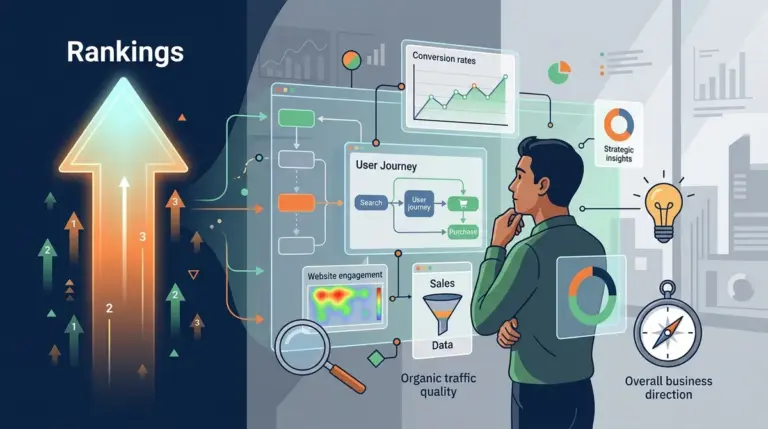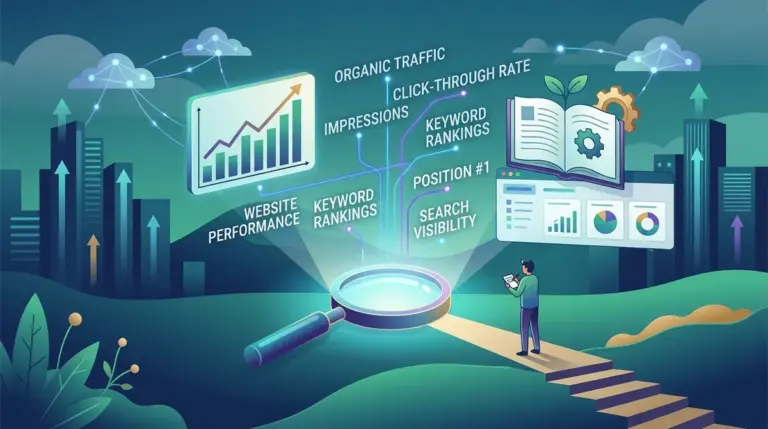

Measuring SEO progress is often the most frustrating part of the learning curve because the feedback loop is delayed. Unlike paid search, where a budget increase yields immediate traffic, SEO requires a "lagging indicator" mindset. If you measure the wrong metrics too early, you may abandon a strategy that is actually working. Conversely, focusing solely on vanity metrics like "total keyword count" can mask a lack of actual revenue growth.
To evaluate your performance accurately, you must distinguish between leading indicators (signs that growth is coming) and lagging indicators (realized business results). This guide outlines the specific data points that signal your SEO efforts are moving from the sandbox to the search results page.
The Essential Measurement Stack
For a beginner, the toolset should be lean to avoid data fatigue. You do not need five different paid subscriptions to understand if your site is growing. You need access to two primary sources of truth:
- Google Search Console (GSC): This is the only tool that provides direct data from Google regarding how often your site appears in search results and which queries are driving clicks. It is the gold standard for technical health and keyword performance.
- Google Analytics 4 (GA4): While GSC tells you what happens on the search engine, GA4 tells you what happens on your website. It tracks user behavior, session duration, and, most importantly, conversions.
Best for: Beginners should prioritize GSC for the first 90 days of a campaign, as it reveals "hidden" progress like impression growth before clicks start to materialize.
Tracking Organic Impressions as a Leading Indicator
Impressions represent the number of times a user saw a link to your site in search results. For a new site or a fresh piece of content, impressions almost always rise before clicks. This is the first sign that Google’s algorithm has indexed your content and finds it relevant to specific queries.
When reviewing GSC, look for a steady upward trend in the "Total Impressions" chart. Even if your "Total Clicks" line remains flat, a rising impression count means you are moving from page 10 to page 3. You aren't getting traffic yet because users rarely click past the first page, but the "climb" is happening. If impressions are stagnant for more than 60 days after publishing, it usually indicates a lack of topical relevance or a technical indexing issue.
Monitoring Keyword Breadth and Average Position
Progress isn't just about ranking #1 for a single "trophy" keyword. It is about expanding your "keyword footprint." This refers to the total number of unique queries that trigger your site to appear in search results.
The Value of Long-Tail Keywords
Beginners often see progress first in long-tail keywords—highly specific phrases with three or more words. While these have lower search volume, they are easier to rank for and often indicate high intent. If your GSC report shows you are appearing for 500 different low-volume queries today compared to 50 last month, your SEO authority is growing. This "breadth" creates a foundation that eventually supports rankings for higher-volume, more competitive terms.
Deciphering Average Position
Average position can be a misleading metric if viewed in isolation. If you launch 10 new pages, your average position might actually drop because those new pages start at rank 80 or 90. This doesn't mean your site is performing worse; it means you have more content in the race. Instead of looking at the site-wide average, filter GSC to look at the average position of your top 10 most important pages individually.
Pro Tip: Do not obsess over daily ranking fluctuations. Google’s index is dynamic, and "rankings" are often personalized based on a user's location and search history. Instead of daily tracking, compare 28-day rolling averages to identify real trends versus algorithmic noise.
Analyzing Click-Through Rate (CTR) for Content Optimization
Once you have achieved rankings on the first or second page, your next metric for progress is CTR. This is the percentage of people who saw your link and decided to click it. A low CTR (below 1-2% for a top-5 position) suggests that while your SEO is working, your "commercial" appeal is failing.
If you see high impressions but low clicks, the progress has stalled at the "visibility" phase. To push it to the "traffic" phase, you must optimize your Meta Titles and Descriptions. Treat these like ad copy. Are you answering the user's intent? Is there a clear reason to click your link over the one above it? Improving CTR is the fastest way to double your traffic without actually improving your rank.
Measuring Engagement and Conversion in GA4
Traffic is a vanity metric if it doesn't lead to an action. In GA4, you should track "Organic Search" as a specific channel to see how these users behave compared to social media or direct visitors. Key metrics include:
- Key Events (Conversions): Did the user sign up for a newsletter, download a guide, or buy a product?
- Engagement Rate: Did the user actually read the content, or did they bounce immediately? A low engagement rate from organic search often means your content didn't match the "search intent" of the keyword you ranked for.
- Average Engagement Time: If users spend 3 minutes on a page, Google views that as a "successful" search, which can further boost your rankings over time.
Building a Monthly Reporting Routine
To stay consistent, create a simple spreadsheet or dashboard that you update on the first of every month. Avoid the urge to check data daily, as SEO moves in weeks and months. Your report should compare the current month to the previous month, as well as the current month to the same month last year (to account for seasonality). Record your total organic clicks, total impressions, and the number of goal completions. If these three numbers are moving up over a 90-day period, your strategy is working, regardless of individual keyword shifts.
Common SEO Progress Questions
How long does it take to see the first signs of SEO progress?
For a new website, you will typically see impression growth within 4 to 8 weeks. Meaningful click growth and first-page rankings for competitive terms usually take 4 to 12 months, depending on the niche's competitiveness and the quality of your backlink profile.
Why did my traffic drop while my rankings stayed the same?
This usually happens due to seasonality or a drop in total search volume for your keywords. For example, search interest for "winter coats" drops in April, regardless of whether you are ranked #1. It can also happen if Google introduces a new Search Engine Results Page (SERP) feature, like a featured snippet or an AI overview, that pushes organic links further down the page.
Is a high bounce rate always a bad sign for SEO?
Not necessarily. In GA4, "bounce rate" has been replaced by "Engagement Rate." If a user lands on your page, finds the phone number they were looking for, and leaves, that might be recorded as a non-engaged session even though the user got exactly what they needed. Look at "Key Events" (conversions) to determine if the traffic is valuable.
Should I track every keyword I target?
No. Focus on your "money keywords"—the ones that directly lead to revenue or leads. Use Google Search Console to monitor the thousands of long-tail variations automatically. Trying to manually track every single keyword will lead to information overload and take time away from content creation.