
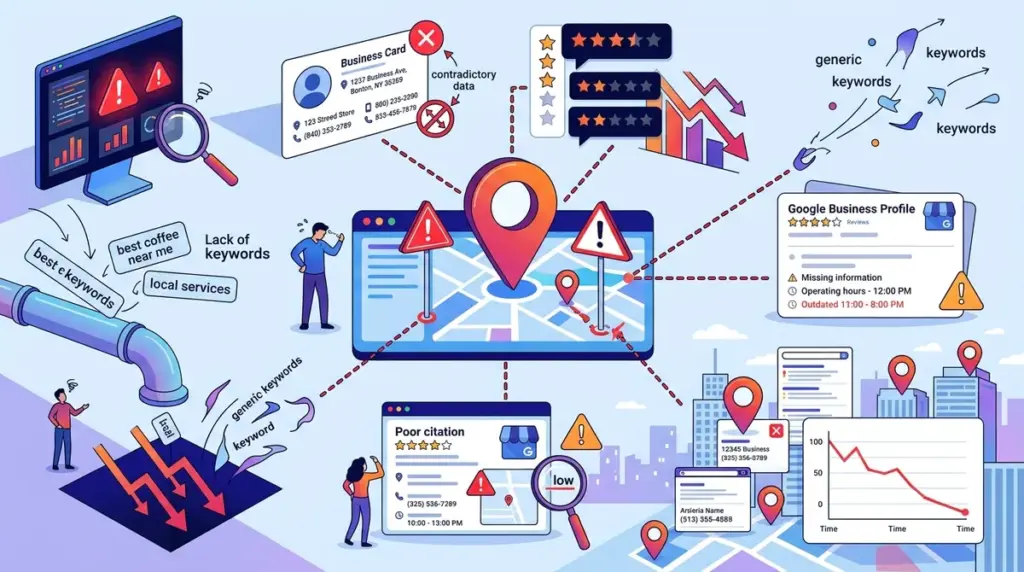
Local SEO errors are often invisible until a storefront notices a drop in walk-in traffic or a contractor’s phone stops ringing. Unlike broad organic search, local rankings rely on high-precision data points that connect a physical location to a specific user intent. When these data points are mismatched or neglected, Google’s algorithm defaults to competitors who provide more reliable geographical signals. For businesses, this is not just a ranking issue; it is a direct loss of revenue from high-intent customers who are ready to buy within a five-mile radius.
Maintaining Inconsistent NAP Data Across the Web
The most frequent technical failure in local search is inconsistent NAP (Name, Address, Phone number) data. Search engines use these details as a verification method. If your business is listed as "Main St. Pizza" on your website but "Main Street Pizzeria" on Yelp, search crawlers may treat them as two separate, less authoritative entities. This fragmentation dilutes your ranking power in the Map Pack.
Best for: Multi-location brands and service-area businesses that have recently rebranded or moved.
- Check for variations in abbreviations (e.g., "Ste." vs "Suite").
- Ensure the phone number matches the local area code rather than a generic 800-number.
- Audit third-party aggregators like Neustar Localeze and Foursquare to flush out legacy data.
Misconfiguring Google Business Profile Categories
Google Business Profile (GBP) allows you to select one primary category and up to nine secondary categories. A common mistake is choosing a primary category that is too broad, such as "Consultant," when "Tax Consultant" is the specific service driving revenue. The primary category carries the most weight in determining which searches trigger your profile.
If you own a fitness center that includes a spa, setting the primary category to "Gym" ensures you appear for high-volume fitness searches, while "Day Spa" as a secondary category captures the niche traffic. Reversing these can lead to a significant drop in your core audience visibility. Avoid the temptation to add irrelevant categories in hopes of "casting a wider net," as this confuses the relevance score for your primary service.
Warning: Never use a P.O. Box or a virtual office address for your Google Business Profile. Google’s guidelines strictly require a physical location where staff are present during stated hours. Using a UPS Store address or a co-working space without a dedicated, private office often leads to immediate account suspension and a lengthy reinstatement process.
Failing to Build Hyper-Local Content
Generic SEO content focused on broad industry terms will not help you rank for "plumber in Des Moines." Many site owners make the mistake of creating one "Service" page and listing 20 cities at the bottom. This is a thin content signal that rarely ranks. Instead, you need dedicated landing pages for each primary service area that include specific local identifiers.
Effective local content includes mentions of nearby landmarks, neighborhood names, and local community involvement. For example, a real estate agent shouldn't just write about "buying a home"; they should write about "the 5 best school districts in North Scottsdale." This demonstrates geographical authority to both the user and the search engine.
Ignoring Review Management and Response Quality
Reviews are a primary ranking factor in the local algorithm, but many businesses treat them as a "set it and forget it" metric. Simply having a high star rating is insufficient. Google looks for "review velocity"—the frequency and consistency of new reviews—and the presence of keywords within the review text.
A major mistake is failing to respond to reviews, or worse, using a generic "Thank you for your business" template for every entry. Responses are an opportunity to reinforce your services. If a customer praises your "emergency roof repair," your response should acknowledge the "emergency roof repair in [City Name]" to help search engines associate your business with that specific keyword and location.
The Risk of Keyword Stuffing Business Names
In an attempt to game the system, many businesses add descriptors to their official name on GBP, such as "Joe’s Plumbing - Best Plumber, Drain Cleaning, & Water Heaters." While this might provide a short-term ranking boost, it is a direct violation of Google’s Terms of Service. Competitors can—and will—report these listings. The result is usually a "hard suspension," which removes your business from Google Maps entirely until you provide legal documentation proving the keyword-stuffed name is your registered DBA (Doing Business As).
Neglecting Mobile User Experience for Local Intent
Local searches are predominantly performed on mobile devices by users who are "on the go." A common mistake is having a website that technically passes a mobile-friendly test but fails the "thumb test." If a user has to pinch-and-zoom to find your phone number or if your "Get Directions" button is buried in a footer, you will lose the conversion. Local SEO is as much about conversion rate optimization (CRO) as it is about rankings. Ensure your Click-to-Call buttons are prominent and your maps load instantly without layout shifts.
Audit Your Local Presence for Long-Term Growth
Correcting local SEO mistakes requires a systematic approach to data integrity. Start by running a scan of your top 20 citations to ensure NAP consistency. Once the foundation is stable, shift focus to your Google Business Profile by optimizing your primary category and implementing a weekly posting schedule for "Updates." Finally, move toward a content strategy that prioritizes neighborhood-level detail over broad industry advice. Local search is a game of proximity and trust; by removing technical friction and providing clear geographical signals, you position your business as the most logical choice for the algorithm to recommend.
Frequently Asked Questions
How long does it take to see results after fixing NAP inconsistencies?
Typically, it takes 4 to 8 weeks for search engines to crawl the updated directories and update their internal index. However, you may see Map Pack fluctuations sooner if you update your Google Business Profile directly.
Can I rank in a city where I don't have a physical office?
It is difficult to rank in the Map Pack for a city where you lack a physical presence. To capture this traffic, you should focus on organic "Local Organic" results by creating high-quality, city-specific landing pages on your main website.
Do social media profiles affect local SEO?
While social signals aren't a direct ranking factor for the Map Pack, active profiles on platforms like Facebook and LinkedIn serve as additional citations. They help verify your business's legitimacy and often appear in branded search results, providing more "real estate" for your business on page one.