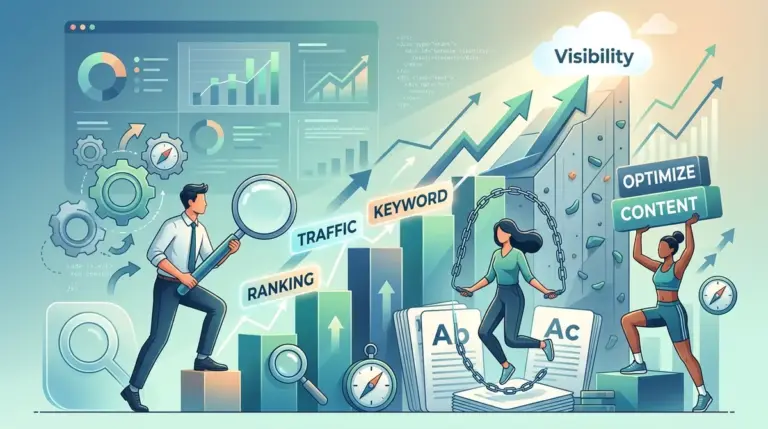
Most SEO guides fail because they treat the discipline as a collection of disconnected hacks rather than a linear process. To move from a beginner to a practitioner who can actually move the needle on organic traffic, you need a structured sequence that mirrors how search engines actually function. This 30-day plan is designed to build that sequence, starting with the technical infrastructure that allows a site to be discovered, moving through the psychological mapping of search intent, and ending with the data-driven analysis required to sustain growth. This structured approach is ideal for those interested in building your own SEO learning plan tailored to their specific needs.
Week 1: The Technical Foundation and Search Mechanics
Before you write a single word of content, you must understand the plumbing. If a search engine cannot crawl or index your pages, your creative efforts are invisible. The first seven days are dedicated to the "how" of search engines.
Days 1–3: Crawling, Indexing, and Ranking
Spend these days learning the three-stage process of Google’s discovery engine. Crawling is the discovery stage where bots follow links; Indexing is the storage stage where pages are categorized; and Ranking is the retrieval stage where algorithms decide which page best answers a query.
- Study the
robots.txtfile to understand how to give instructions to crawlers. - Learn the difference between a 404 (Not Found) and a 301 (Permanent Redirect) and how they impact "link juice."
- Explore the concept of "Crawl Budget" and why bloated site structures hurt large-scale SEO performance.
Days 4–7: Site Architecture and Core Web Vitals
Google prioritizes user experience. Use these days to understand how site speed and structure influence rankings. Focus on the "Flat Site Architecture" model, where any page on a site is reachable within three clicks from the homepage. This ensures that internal link equity—the "authority" passed from one page to another—is distributed efficiently.
Best for: Developing a logical hierarchy that both users and bots can navigate without friction.
Warning: Do not ignore the mobile-first index. Google now predominantly uses the mobile version of content for indexing and ranking. If your desktop site is perfect but your mobile site is missing content or has slow-loading elements, your rankings will suffer regardless of your keyword strategy.
Week 2: Keyword Research and Intent Mapping
Keywords are no longer about repeating a phrase a specific number of times. Modern SEO is about matching the "intent" behind a search query. Week two shifts the focus from the machine to the user.
Days 8–11: The Mechanics of Keyword Research
Learn to use tools like Google Keyword Planner, AnswerThePublic, or specialized SEO suites to find high-volume, low-competition opportunities. However, do not rely solely on "Search Volume" metrics. High volume often indicates high competition and broad intent, which is difficult for beginners to rank for. Instead, look for "Long-Tail Keywords"—phrases with three or more words that indicate a specific need. By focusing on long-tail keywords, you can begin to establish a foothold, forming the basis of a simple SEO learning roadmap.
Days 12–14: Categorizing Search Intent
Every search falls into one of four categories. Your content must match the category, or it will never rank in the top 10:
- Informational: The user wants an answer (e.g., "how to fix a leaky faucet").
- Navigational: The user is looking for a specific brand or site (e.g., "Facebook login").
- Commercial: The user is researching products (e.g., "best ergonomic chairs 2024").
- Transactional: The user is ready to buy (e.g., "buy iPhone 15 Pro Max").
If you target a transactional keyword with an informational blog post, you are fighting an uphill battle against Google's understanding of what the user actually wants.
Week 3: On-Page Optimization and Content Strategy
With a technical foundation and a list of intent-mapped keywords, you can now begin optimizing individual pages. This is where you translate your research into visible results.
Days 15–18: The Anatomy of an Optimized Page
On-page SEO is about providing "relevancy signals" to search engines. You must master the placement of keywords in high-value areas without over-optimizing. Focus on the following elements:
Title Tags: These are the most important on-page signal. Keep them under 60 characters and place your primary keyword near the beginning.
Meta Descriptions: While not a direct ranking factor, these act as your "ad copy" in the search results. A compelling description increases Click-Through Rate (CTR), which is a secondary signal of quality.
Header Tags (H2, H3): Use these to create a logical outline. They help Google understand the sub-topics covered within your main article.
Days 19–21: E-E-A-T and Content Quality
Experience, Expertise, Authoritativeness, and Trustworthiness (E-E-A-T) are the pillars Google uses to evaluate content, especially in "Your Money or Your Life" (YMYL) niches like finance or health. Spend these days learning how to cite sources, include author bios that prove expertise, and ensure your content provides more value than the top three results currently ranking for your target term.
Week 4: Off-Page Authority and Performance Tracking
The final week is about building the "reputation" of your site and learning how to measure whether your efforts are actually working. SEO is not a "set it and forget it" discipline; it requires constant iteration based on data.
Days 22–26: Link Building and Off-Page Signals
Backlinks—links from other websites to yours—act as votes of confidence. However, not all links are equal. A single link from a high-authority, relevant site (like a major industry publication) is worth more than a thousand links from low-quality, irrelevant blogs. Focus on "Digital PR" and "Resource Page Link Building." Avoid "Black Hat" techniques like buying links, as these lead to manual penalties that can de-index your site entirely.
Days 27–30: Measuring Success with GSC and GA4
You cannot improve what you do not measure. Use the final days of the month to master Google Search Console (GSC) and Google Analytics 4 (GA4).
- Google Search Console: Use this to monitor which queries bring people to your site, identify crawl errors, and submit sitemaps.
- GA4: Use this to track user behavior once they arrive. Look at "Engagement Rate" and "Key Events" (conversions) to see if your SEO traffic is actually helping your business goals.
Transitioning from Theory to Live Implementation
After 30 days, you have the theoretical framework to manage a website's organic growth. The next step is to perform a "Mini-Audit" on a live site. Apply what you have learned by identifying one technical error, one keyword gap, and one on-page optimization opportunity. SEO is a momentum-based game; the insights you gain from your first 30 days will serve as the baseline for the advanced strategies—such as schema markup and international SEO—that you will encounter as you progress into intermediate territory.
Common SEO Learning Questions
How long does it take to see results from these steps?
SEO is a long-term investment. While technical fixes (like fixing a 404 error) can show results in days, content and link-building efforts typically take 3 to 6 months to manifest in significant ranking shifts. This timeline depends heavily on the competition level of your niche.
Do I need to learn how to code to be good at SEO?
No, but you should be able to read basic HTML. Understanding how tags like <canonical>, <alt>, and <h1> work in the source code allows you to troubleshoot issues that a CMS (like WordPress) might obscure.
Which tools are essential for a beginner on a budget?
Google Search Console and Google Analytics are non-negotiable and free. For keyword research, the free versions of tools like Ubersuggest or the "People Also Ask" sections in Google search results provide enough data to get started without a paid subscription.