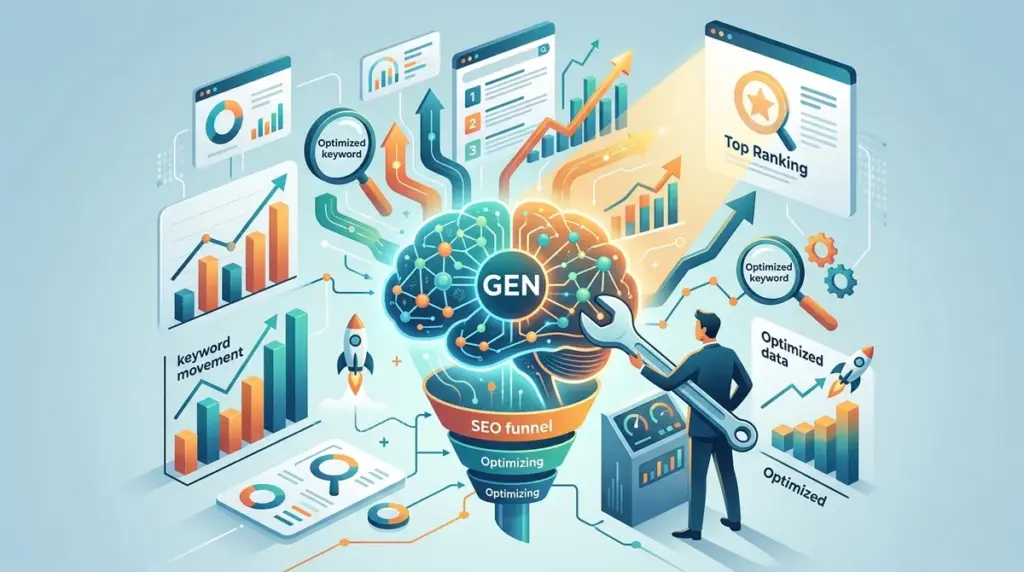
Generative Engine Optimization (GEO) is the strategic process of preparing content to be retrieved, cited, and synthesized by AI-driven answer engines. While traditional SEO focuses on securing a spot in the "ten blue links," GEO aims for inclusion within the narrative responses generated by platforms like Google Search Generative Experience (SGE), Perplexity AI, and OpenAI’s SearchGPT. For marketers and site owners, this shift represents a move from optimizing for a ranking algorithm to optimizing for a large language model (LLM) that prioritizes source credibility and contextual relevance. This strategic shift means understanding how to stay valuable as an SEO in the age of AI is paramount for continued success.
Best for: Content publishers, B2B brands, and technical documentation sites that rely on being the authoritative source for complex queries.
The Mechanics of Generative Search
To understand GEO, you must understand Retrieval-Augmented Generation (RAG). Unlike traditional search engines that crawl and index pages to serve a list of URLs, generative engines use RAG to pull specific data points from the web in real-time and blend them into a coherent answer. The engine isn't just looking for the most relevant page; it is looking for the most "extractable" and "reliable" information fragments to build its response. Understanding these underlying mechanisms helps address the AI content and SEO risks beginners should know.
The generative engine evaluates content based on its ability to support a factual claim. If your content provides a clear, data-backed answer to a user’s prompt, the LLM is more likely to include your brand as a cited source. This creates a new hierarchy of visibility where being the primary citation in an AI summary can drive higher quality, high-intent traffic than a standard organic position.
Core Differences Between SEO and GEO
Traditional SEO relies heavily on backlink profiles, keyword density, and technical site health. While these remain foundational, GEO introduces new variables that dictate visibility in an AI-synthesized environment.
From Keywords to Entity Relationships
Generative engines do not look at keywords in isolation. They look at entities—people, places, things, and concepts—and the relationships between them. If a user asks about the "best hiking boots for wide feet," the engine looks for content that connects specific boot models (entities) with the attribute of "wide toe boxes" and "long-distance durability." GEO requires you to define these relationships explicitly within your content, often using structured data to help the LLM connect the dots.
The Role of Citation and Attribution
In a standard Google search, the user clicks a link and finds the information. In a generative search, the engine provides the information directly. The "win" for the publisher is the citation link embedded in the text. Research into GEO suggests that engines prioritize content that uses authoritative language, includes direct quotes from experts, and provides unique data. Content that is "fluffy" or generic is often ignored because it offers nothing unique for the LLM to synthesize.
Tactics for Optimizing for LLMs
Optimizing for generative engines requires a shift toward information density. Every paragraph must serve a purpose, providing a fact, a statistic, or a unique insight that the AI can use as a building block for its answer.
- Cite Authoritative Sources: LLMs are programmed to avoid "hallucinations" (making things up). By citing peer-reviewed studies, government data, or recognized industry experts, you make your content a safer bet for the AI to reference.
- Use Statistics and Data Points: Hard numbers are highly extractable. A sentence like "Our tool increases efficiency by 22% based on a 2023 internal audit" is more likely to be cited than "Our tool makes you much more efficient."
- Implement Advanced Schema: Beyond basic Article schema, use Speakable, FactCheck, and Product schema to give the engine a structured roadmap of your content’s key claims.
- Adopt an Authoritative Tone: Generative engines favor content written in a professional, objective, and confident voice. Avoid overly promotional language that can be flagged as biased.
- Optimize for "Niche" Queries: LLMs excel at answering long-tail, complex questions. Create content that answers the "how" and "why" of your industry in granular detail.
Warning: Avoid "keyword stuffing" for generative engines. LLMs are designed to understand natural language and semantic intent; over-optimizing for a single phrase can make your content appear lower-quality to the model’s filtering layers, leading to exclusion from the final summary.
Measuring Success in a Zero-Click Environment
One of the biggest challenges with GEO is the "zero-click" nature of generative search. If the user gets the answer from the AI, they may not click through to your site. However, this does not mean the impression is worthless. Success in GEO is measured through "Brand Share of Voice" within the AI response and "Citation Frequency."
Marketers should track how often their brand is mentioned in AI summaries for core industry queries. Tools that simulate SGE or Perplexity results are becoming essential for this. Furthermore, look at the quality of the traffic that does click through. Users who click a citation link in a generative answer are often further down the funnel and more informed than those clicking a standard search result, leading to higher conversion rates despite lower overall traffic volumes.
Immediate Steps for GEO Implementation
To begin transitioning your strategy, start by auditing your top-performing organic pages. Identify where you can add "citation-worthy" elements. This might mean adding a "Key Statistics" box at the top of an article or integrating quotes from your internal subject matter experts. Ensure that your most important claims are supported by external links to high-authority domains.
Next, focus on technical clarity. Ensure your site’s HTML structure is clean so that LLM crawlers can easily parse your headers and lists. Use H2 and H3 tags to create a logical flow that an AI can follow. If the AI can’t easily determine which part of your page answers a specific question, it will move on to a competitor’s site that is better structured.
Frequently Asked Questions
Does GEO replace traditional SEO?
No. GEO is an extension of SEO. Traditional search engines still drive the majority of web traffic, but GEO ensures you are visible in the growing segment of AI-assisted searches. You need both to maintain a competitive digital presence.
Which AI engines should I prioritize?
Currently, Google SGE is the most critical due to its massive user base. However, Perplexity AI is gaining traction among power users, and SearchGPT is a significant upcoming competitor. Optimizing for factual density and clear citations generally works across all these platforms.
Will AI engines steal my traffic?
While some informational queries will result in fewer clicks, GEO allows you to capture high-intent users who need deep-dive information. By being the cited source, you establish brand authority that a simple blue link cannot match, often leading to better conversion metrics.