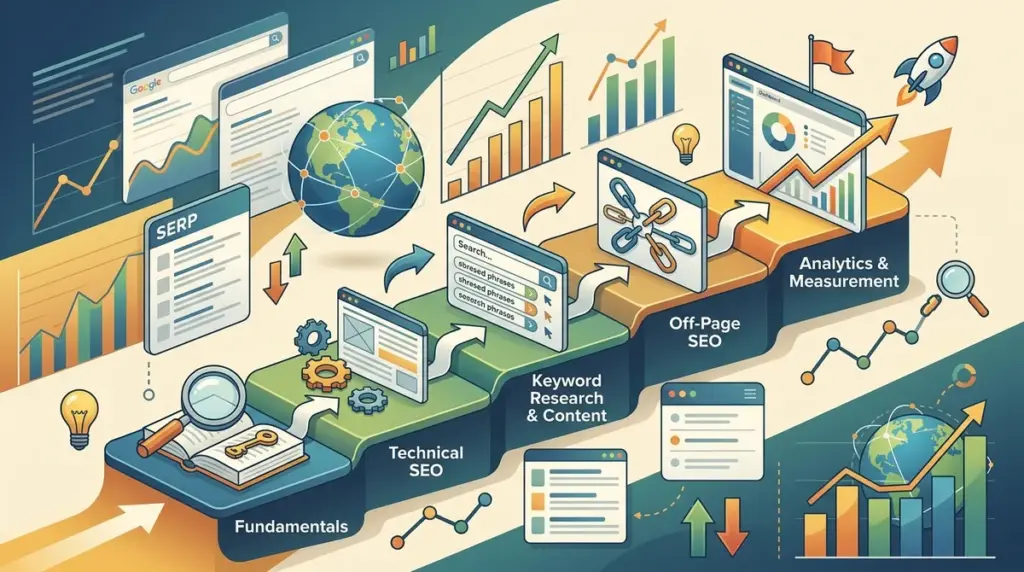
Learning SEO in the wrong order leads to "optimization debt"—a state where you spend more time fixing fundamental architectural errors than growing traffic. Most beginners dive straight into link building or complex technical audits because those topics generate the most noise in industry forums. However, trying to build authority for a site that search engines cannot crawl is a waste of resources. The most efficient path follows the path of a search engine bot: discovery, understanding, and evaluation. Understanding this efficient path can help you gauge how long it takes to learn SEO effectively.
Establishing the Foundational Mechanics
Before you can optimize a page, you must understand how a search engine finds it. This stage is about the mechanics of the web. If you do not understand the relationship between a server request and a rendered page, you will struggle to diagnose why certain pages aren't appearing in search results.
Focus on: HTTP status codes (200, 301, 404, 500), the difference between crawling and indexing, and the role of the robots.txt file. You need to know that a "noindex" tag is a directive, while robots.txt is often just a crawl suggestion. Learning these distinctions early prevents you from accidentally de-indexing entire sections of a site during later experiments.
Best for: Building a mental model of how Googlebot interacts with a server.
Keyword Research and the Logic of Intent
Once you understand how bots access pages, you need to decide what those pages should talk about. Keyword research is not just about finding high-volume terms; it is about mapping human problems to digital solutions. This is where many marketers fail by targeting "vanity metrics" rather than "conversion intent."
- Seed Keywords: Broad terms that define your industry.
- Long-Tail Keywords: Specific, multi-word phrases that often carry higher conversion rates.
- Search Intent: Categorizing queries into Informational, Navigational, Commercial, or Transactional buckets.
- Keyword Difficulty: A metric that estimates how hard it is to displace current top-ranking pages.
You must learn to look at a Search Engine Results Page (SERP) and identify what Google thinks the user wants. If the top 10 results for a keyword are all "How-to" guides, trying to rank a product category page for that term is a losing battle regardless of your backlink profile.
On-Page SEO and Content Architecture
With your keywords selected, you must now learn to communicate that relevance to both users and bots. On-page SEO is the most "controllable" aspect of the discipline. It involves the strategic placement of keywords and the structural organization of information. This focus on content and structure makes it a great starting point for those interested in learning SEO without coding.
Master the use of Title Tags and Meta Descriptions first. These are your "organic ad copy." A high-ranking page with a poor title tag will suffer from a low Click-Through Rate (CTR). Next, move into header hierarchy (H2s and H3s). These aren't just for styling; they provide a semantic outline of your content. You should also learn about internal linking—how to pass "link equity" from your most powerful pages to your newest ones.
Warning: Avoid "keyword stuffing" at all costs. Modern search algorithms use Latent Semantic Indexing (LSI) and entity recognition. If you use the exact same keyword 50 times, you risk a spam penalty. Focus on using primary keywords in the first 100 words and supporting them with synonyms and related concepts throughout the body text.
Technical SEO Infrastructure
Technical SEO ensures that your site meets the high performance standards required for modern ranking. This is where you learn about site speed, mobile-friendliness, and Core Web Vitals. As you progress, you should study Schema Markup (Structured Data). This is a specific vocabulary you add to your HTML to tell search engines exactly what your data means—for example, distinguishing a "Review" from a "Product price."
Best for: Improving the "Quality Score" of the entire domain and ensuring a smooth user experience.
You should also learn about URL structure. A clean, descriptive URL like SEO Learning Center/red-running-shoes is always superior to SEO Learning Center/p=12345. Technical SEO also covers canonicalization, which tells Google which version of a page is the "master" copy to prevent duplicate content issues.
Off-Page SEO and Authority Building
After your site is fast, crawlable, and relevant, you need to prove to search engines that it is trustworthy. This is the most difficult and time-consuming part of SEO. It involves earning links from other reputable websites. A link is essentially a "vote of confidence."
Do not start with "link schemes" or buying cheap links. Learn the art of "link earning" through high-quality content, digital PR, and broken link building. You must also understand the difference between "Dofollow" and "Nofollow" links. While Nofollow links (like those from social media) don't pass direct ranking power, they are essential for a natural-looking backlink profile.
Analytics, Reporting, and Iteration
The final stage is learning how to measure what you’ve done. SEO is not a "set it and forget it" task. It requires constant monitoring of Google Search Console (GSC) and tools like Google Analytics 4 (GA4). You need to be able to identify which pages are losing traffic and why. Is it a seasonal dip? Did a competitor publish something better? Or did a technical error break the page?
Best for: Proving ROI to stakeholders and identifying new growth opportunities based on real user data.
Building Your First Optimization Roadmap
To put this order into practice, start with a small, manageable project. Begin by auditing a 5-page website for crawl errors. Once those are fixed, perform keyword research for one specific service the site offers. Write a high-quality article targeting those keywords, ensuring your headers and meta tags are optimized. Finally, reach out to one industry blog to see if they will reference your new resource. By following this sequence, you ensure that every hour spent on SEO builds upon a solid, functional foundation rather than a shaky one.
Common SEO Learning Questions
How long does it take to learn the basics of SEO?
Most marketers can grasp the fundamental concepts of crawling, indexing, and on-page optimization within 20 to 30 hours of focused study. However, mastering the nuances of technical audits and high-level link-building strategy typically takes six months to a year of hands-on practice.
Do I need to know how to code to learn SEO?
You do not need to be a software engineer, but a basic understanding of HTML and CSS is highly beneficial. Knowing how to read a page's source code allows you to verify if tags are implemented correctly without relying solely on third-party tools.
Which SEO tool should I learn first?
Start with Google Search Console. It is a free tool provided by Google that shows exactly how the search engine sees your site, which keywords are driving traffic, and if there are any manual penalties or security issues affecting your rankings.
Is technical SEO more important than content?
They are interdependent. Technical SEO is the floor; content is the ceiling. Without technical SEO, your content may never be seen. Without high-quality content, your technical perfection has nothing to rank. Always prioritize a "technically sound" site before investing heavily in content production.