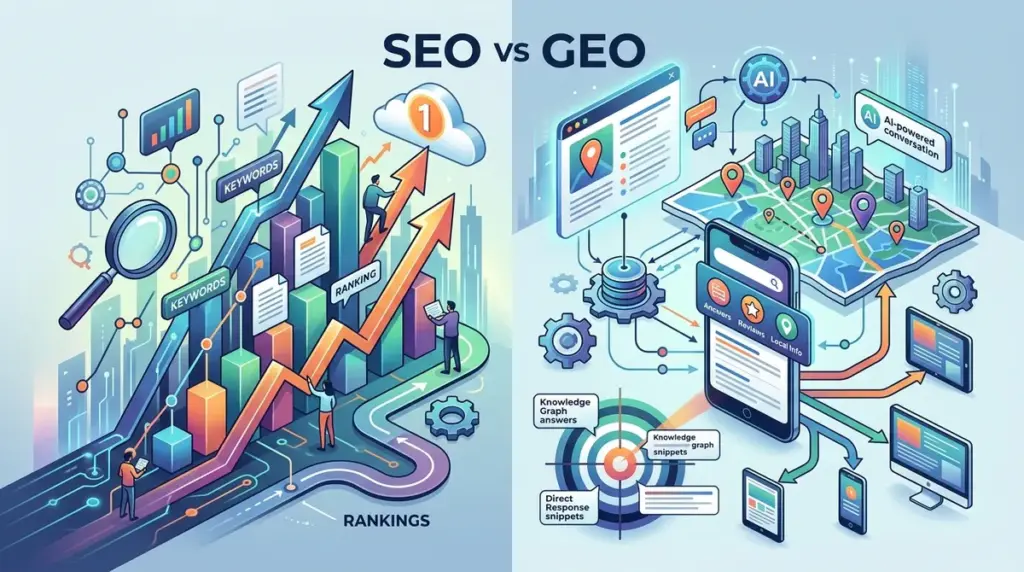
Search engines are undergoing a fundamental shift from indexing pages to synthesizing answers. For two decades, Search Engine Optimization (SEO) has focused on earning a spot in a list of results. Now, Generative Engine Optimization (GEO) has emerged as the discipline of influencing the responses generated by Large Language Models (LLMs) like those powering Perplexity, SearchGPT, and Google’s AI Overviews. While SEO aims to drive traffic to a website, GEO aims to ensure a brand is the primary source cited when an AI answers a user’s question directly. Navigating this paradigm shift requires a proactive approach to staying valuable as an SEO professional in the rapidly evolving digital landscape.
The Mechanics of Traditional SEO
Traditional SEO is built on the premise of the "click." The goal is to optimize a webpage so that a search engine algorithm—primarily Google’s—recognizes it as the most relevant and authoritative result for a specific keyword. This process relies on three pillars: technical health, content relevance, and backlink authority.
Best for: Driving direct organic traffic, lead generation through landing pages, and long-form educational content where the user needs to interact with a specific UI or tool.
In SEO, success is measured by SERP (Search Engine Results Page) positioning. If you rank in the top three for a high-intent keyword, you expect a predictable click-through rate (CTR). The strategy involves mapping keywords to specific URLs and ensuring those URLs provide a superior user experience (UX) to keep the visitor on the site once they arrive.
GEO: Optimizing for the Answer Engine
GEO shifts the focus from ranking a URL to influencing a model's latent knowledge. Generative engines do not just list links; they scrape, summarize, and synthesize information from multiple sources to provide a single, cohesive response. To "rank" in GEO means to be included in the AI’s summary and, crucially, to be cited as a source.
Recent research into GEO suggests that traditional SEO tactics, like keyword density, are less effective than "authoritative density." This involves using statistics, expert quotes, and highly structured data that an LLM can easily parse and verify. The goal is to become the "ground truth" for the AI.
Core Tactical Differences
The transition from SEO to GEO requires a change in how content is structured and distributed. While the two overlap, their primary levers of influence differ significantly:
- Keyword Targeting vs. Intent Modeling: SEO targets specific phrases (e.g., "best project management software"). GEO targets the multi-step reasoning an AI performs to answer a complex prompt (e.g., "Compare project management tools for a 50-person remote creative agency focusing on budget and Jira integration").
- Backlinks vs. Citations: In SEO, a link from a high-authority site passes "link juice." In GEO, the frequency and context of brand mentions across diverse, reputable sources matter more. The AI needs to see your brand associated with specific topics across its entire training set.
- Content Length vs. Information Density: SEO often rewards comprehensive, long-form content that covers every facet of a topic. GEO rewards "snackable" facts, clear data points, and concise definitions that are easy for an LLM to extract and insert into a generated summary.
- HTML Structure vs. Semantic Schema: While SEO uses H-tags for readability and hierarchy, GEO leans heavily on SEO Learning Center and JSON-LD to provide explicit context that eliminates ambiguity for the AI.
Warning: Over-optimizing for GEO by using overly clinical or "robotic" language can damage your traditional SEO rankings. Google’s Helpful Content guidelines still prioritize human-centric readability. The most effective strategy uses structured data for the bots while maintaining a narrative voice for the humans who eventually click the citations. Beginners especially need to be aware of the potential AI content and SEO risks that can arise from prioritizing bots over human readers.
How GEO Impacts the Marketing Funnel
The most significant commercial difference between SEO and GEO is where they sit in the buyer’s journey. SEO remains the king of the "transactional" and "navigational" stages. If a user wants to "buy red running shoes," they want a list of stores, which SEO provides.
GEO dominates the "informational" and "consideration" stages. When a user asks an AI, "What are the pros and cons of minimalist running shoes for marathon training?" they are looking for a synthesis of expert opinion. If your brand is cited in that synthesis, you gain immediate authority without the user ever having to visit your site. This creates a "zero-click" environment where brand awareness happens within the search interface itself.
The Role of Structured Data in GEO
To succeed in GEO, your technical setup must go beyond basic meta tags. Generative engines rely on structured data to understand the relationship between entities. For example, using "Product" and "Review" schema allows an AI to pull specific pricing and rating data into a comparison table it generates for a user. Without this explicit markup, the AI may hallucinate details or, worse, ignore your site entirely in favor of a competitor with clearer data structures.
Authoritative Citations and Brand Mentions
GEO success is highly correlated with "Digital PR." Because LLMs are trained on massive datasets including news sites, forums, and social media, your brand must appear in these locations. It is no longer enough to have a blog on your own domain. To influence a generative engine, your brand’s unique insights and data must be referenced by third-party journalists, industry researchers, and in public discussions. This builds the "consensus" that AI models look for when verifying facts.
Building a Hybrid Search Strategy
Rather than choosing between SEO and GEO, marketers must integrate both into a single visibility strategy. This involves auditing existing content to ensure it serves both the crawler and the model. Start by identifying your highest-performing SEO pages and adding "GEO layers" to them: concise summaries, clear data tables, and explicit citations of your own original research.
Next, shift your measurement framework. Track traditional metrics like organic sessions and keyword rankings for SEO, but add "Inclusion Rate" and "Citation Share" for GEO. Tools that track how often your brand appears in AI-generated answers are becoming essential for understanding your true market share in an AI-first world.
Frequently Asked Questions
Does GEO replace traditional SEO?
No. SEO is still necessary for driving direct traffic and conversions. GEO is an evolution that addresses how users interact with AI-driven search interfaces. They are complementary strategies that target different parts of the user experience.
What is the most important factor for GEO ranking?
Information density and factual accuracy. Generative engines prioritize sources that provide clear, verifiable data points, statistics, and direct answers that can be easily synthesized into a summary.
How do I track my GEO performance?
Standard analytics like Google Search Console do not yet provide full visibility into AI Overviews or third-party LLM citations. You must use specialized monitoring tools or manually prompt AI engines to see if your brand is being cited for key industry queries.
Will GEO reduce my website traffic?
In many cases, yes. GEO contributes to "zero-click" searches where the user gets their answer without leaving the search engine. However, the traffic that does click through from a citation is often higher intent, as the user has already been "sold" on your authority by the AI’s summary.