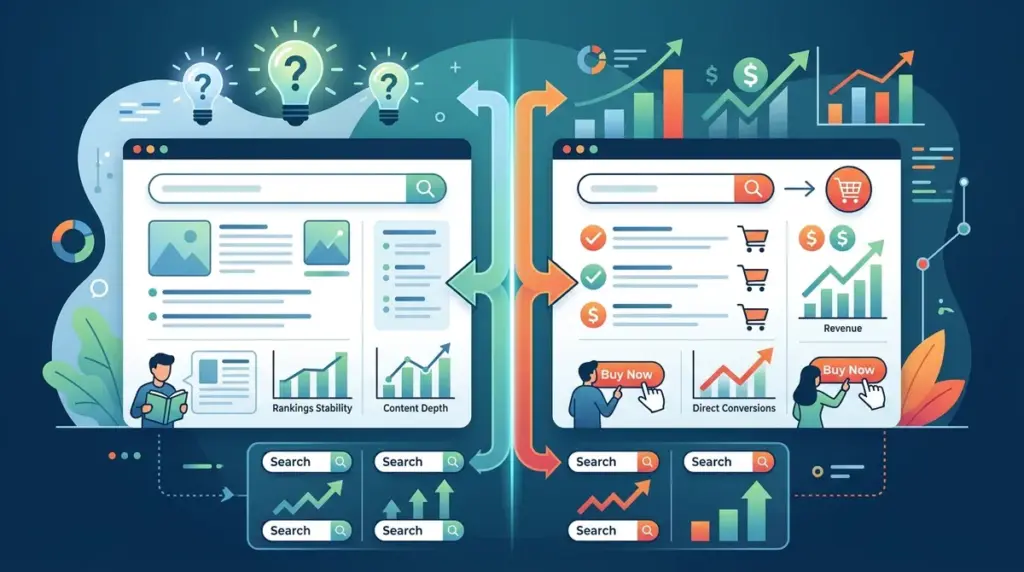
Search engine optimization fails when the intent of a webpage does not match the intent of the user’s query. You can rank for a high-volume term, but if a user looking for a tutorial lands on a product page, they will bounce. Conversely, if a user ready to buy lands on a 3,000-word history of the product, they will find a competitor who offers a direct checkout path. Distinguishing between informational and transactional keywords is the first step in building a conversion-oriented content map.
The Fundamental Split in Search Intent
Every search query carries an underlying goal. While the SEO industry often categorizes intent into four buckets—informational, navigational, commercial investigation, and transactional—the most critical divide for resource allocation is between information-seeking and action-taking. Informational keywords serve the "learn" phase, while transactional keywords serve the "buy" phase. Understanding this distinction prevents the common error of trying to force a product page to rank for a "how-to" query.
Informational Keywords: The Foundation of Authority
Informational keywords are used when a searcher is looking for specific facts, instructions, or solutions to a problem. These queries typically occur at the Top of the Funnel (TOFU). While they rarely lead to an immediate sale, they are essential for capturing lead data, building brand awareness, and establishing the topical authority necessary to rank for more competitive terms later.
Best for: Blog posts, whitepapers, FAQ sections, and educational video content.
Informational queries are often phrased as questions or broad topics. Common modifiers include:
- How to...
- What is...
- Ways to...
- Guide to...
- History of...
- Examples of...
For example, a user searching for "how to fix a leaky faucet" is looking for a step-by-step guide. If a plumbing company directs this user to a "Book an Appointment" landing page, the user will leave. However, if the company provides a high-quality video tutorial, they earn the user's trust. When that user eventually decides the job is too big for a DIY fix, that company is the first one they call. This is the long-game value of informational keywords.
Transactional Keywords: The Revenue Drivers
Transactional keywords indicate a high "commercial intent." The user has finished their research and is now ready to complete a purchase or a specific action. These queries are the most valuable in terms of immediate ROI but are also the most expensive to target via paid search and the most competitive in organic results.
Best for: Product pages, category pages, and service sign-up forms.
These keywords are characterized by high-intent modifiers such as:
- Buy...
- Price...
- Discount...
- For sale...
- Shipping...
- Order...
A query like "buy ergonomic office chair" is purely transactional. The SERP for this term will be dominated by e-commerce product grids and shopping ads. If you attempt to rank an informational blog post titled "The Benefits of Ergonomic Chairs" for this specific keyword, you will struggle to break into the top positions because Google recognizes that the user’s goal is to browse inventory, not read an essay.
Warning: Do not rely solely on keyword research tools to determine intent. Always perform a manual SERP check. If the first page is filled with product listings, the intent is transactional. If it is filled with articles and "People Also Ask" boxes, the intent is informational. Forcing the wrong content type against the SERP reality is a waste of budget.
The Critical Middle Ground: Commercial Investigation
Between informational and transactional lies "commercial investigation." These keywords are used by people who know they want to buy but haven't decided on a specific product or brand yet. Phrases like "best CRM for small business" or "iPhone 15 vs Samsung S24" fall into this category.
From a content strategy perspective, these should be treated as high-value informational content. They require comparison tables, "pros and cons" lists, and objective reviews. They bridge the gap by answering informational questions that lead directly to a transactional decision.
Mapping Keywords to Your Site Architecture
To maximize SEO performance, you must assign every keyword in your research to a specific page type based on its intent. A common mistake is "keyword cannibalization," where an informational blog post and a transactional product page compete for the same term, confusing the search engine and splitting your ranking signals.
Informational Mapping: These keywords should live in your "Learning Center," blog, or resources section. Their primary goal is to earn backlinks and move users into an email funnel or remarketing list.
Transactional Mapping: These keywords must be the primary targets for your core site structure—your homepage, service pages, and product categories. These pages should be optimized for speed, UX, and clear Calls to Action (CTAs).
Analyzing SERP Features to Verify Intent
Google’s layout provides a visual cheat sheet for keyword intent. By looking at the features present on the results page, you can reverse-engineer what Google thinks the user wants.
If you see a Featured Snippet or a Knowledge Panel, Google has classified the intent as informational. The engine is trying to provide a direct answer. If you see Google Shopping Ads or Local Map Packs with business hours and "Directions" buttons, the intent is transactional or local-transactional. Aligning your content format with these features is non-negotiable for modern SEO.
Audit Your Content for Intent Alignment
To improve your current rankings, perform an intent audit of your top 20 pages. Identify any page that has a high impression count but a very low click-through rate (CTR) or a high bounce rate. Often, this indicates an intent mismatch.
If a product page is trying to rank for an informational "how-to" term, consider creating a new blog post for that term and linking it to the product page. This satisfies the user's immediate need for information while providing a clear path to the transaction once they are ready. This "hub and spoke" model ensures you capture users at every stage of the buyer's journey without sacrificing the user experience.
Actionable Intent Workflow
To implement an intent-based strategy, follow these steps during your next content cycle:
- Group your keyword list by modifier (e.g., all "how to" vs. all "buy").
- Search for the top three keywords in each group and note the SERP features.
- Cross-reference these keywords against your existing pages to ensure no two pages are targeting the same intent for the same topic.
- Update the CTAs on informational pages to be "soft" (e.g., "Download the Guide") and the CTAs on transactional pages to be "hard" (e.g., "Add to Cart").
Frequently Asked Questions
Can a keyword have both informational and transactional intent?
Yes, this is known as "fractured intent." For example, "SEO software" might bring up both product pages and "best of" listicles. In these cases, Google usually provides a mix of results. To rank, you must determine which intent is dominant by looking at the top three organic spots.
Which intent type is better for building backlinks?
Informational keywords are significantly better for link building. Other websites and journalists prefer to link to useful resources, data, and guides rather than commercial sales pages. You can then use internal linking to pass that "link juice" from your informational pages to your transactional ones.
How do I fix a page that is ranking for the wrong intent?
If your page is ranking for a keyword but not converting, evaluate the content. If the keyword is informational but your page is a sales pitch, rewrite the content to be educational. Add a clear, non-intrusive link to your product at the end of the helpful content to bridge the gap.