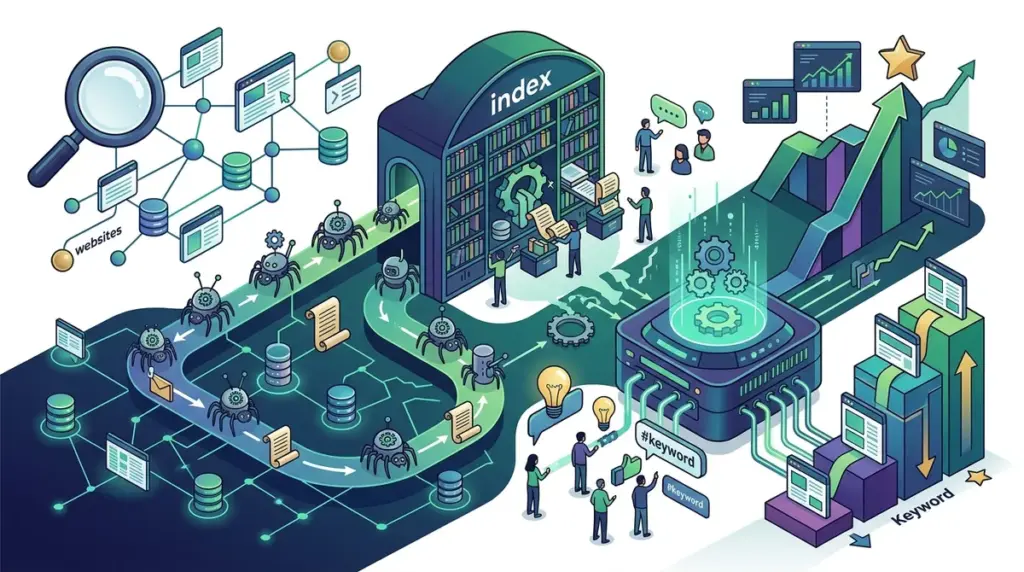
Understanding how search engines function is the difference between guessing at growth and engineering it. For site owners and marketers, the search engine is not a magic box; it is a resource-constrained software system that follows a strict sequence of discovery, analysis, and retrieval. If your content fails at any stage of this three-part pipeline—crawling, indexing, or ranking—it remains invisible to users, regardless of its quality. Mastering these fundamentals allows you to diagnose why pages aren't appearing in results and how to structure a site that search bots can navigate efficiently. Mastering these fundamentals allows you to diagnose why pages aren't appearing in results and how to structure a site that search bots can navigate efficiently, understanding what search engine optimization entails.
The Discovery Phase: Crawling and the Link Graph
Search engines start with crawling, the process of sending out a team of robots (known as crawlers or spiders) to find new and updated content. Google’s primary crawler is Googlebot. It doesn't browse the web like a human; it moves through a list of URLs generated from previous crawls and sitemaps provided by site owners.
Primary Mechanism: Crawlers use links to discover new pages. When a bot lands on a page, it parses the HTML and follows the href attributes of every link it finds. This creates a massive "link graph" that connects the entire web. If a page has no internal or external links pointing to it—an "orphan page"—the crawler will likely never find it unless it is manually submitted via a sitemap.
Crawl Budget Constraints: Search engines do not have infinite resources. They assign a "crawl budget" to every site based on its authority and how often it updates. If your site has thousands of low-value pages, like thin category filters or duplicate URL parameters, the bot may exhaust its budget before it reaches your high-priority commercial pages. This is why technical SEO focuses heavily on directing bots away from "junk" URLs and toward high-value content. This is why technical SEO focuses heavily on directing bots away from "junk" URLs and toward high-value content, avoiding common beginner SEO mistakes.
Warning: Blocking a page in your robots.txt file stops the crawler from accessing it, but it does not necessarily remove it from the index if other sites link to it. To ensure a page never appears in search, use a "noindex" meta tag instead of a robots.txt block.
The Storage Phase: Processing and Indexing
Once a crawler finds a page, the search engine attempts to understand what the page is about. This is the indexing phase. Think of the index as a massive digital library. The search engine doesn't just store the URL; it parses the text, images, and video files to categorize the content.
During this stage, the search engine performs several critical tasks:
- Canonicalization: If the bot finds three versions of the same page (e.g., http, https, and a tracking URL), it decides which one is the "master" version to show in results.
- Content Analysis: It identifies the primary topic by looking at headers (H1, H2), metadata, and the semantic relationship between words on the page.
- Rendering: Modern search engines now render pages like a browser to see how JavaScript affects the content. If your key text is hidden behind a "click to expand" button that requires complex JS, the indexer might miss it.
Best for Visibility: Ensure your most important content is delivered in plain HTML whenever possible. While Google is better at rendering JavaScript than it was five years ago, relying on it increases the "rendering cost," which can delay how quickly your content is indexed.
The Retrieval Phase: Ranking and Intent Matching
Ranking is the final step where the search engine sorts through billions of indexed pages to find the most relevant results for a specific query. This happens in milliseconds. Ranking isn't a static score; it is a dynamic calculation based on hundreds of signals that change depending on the user’s location, device, and search history.
Search engines prioritize two main factors: Relevance and Authority. Relevance is determined by how well your content matches the user's intent. If a user searches for "how to fix a leak," the engine will prioritize educational tutorials over product pages for plumbing supplies. Authority is largely determined by backlinks—links from other reputable websites that act as "votes of confidence" for your content.
The Role of User Experience Signals
In recent years, search engines have shifted toward "Page Experience" signals. This means that even if your content is perfect, you may rank lower if the page takes five seconds to load or if the layout shifts unexpectedly while a user is reading. These metrics, such as Core Web Vitals, provide a measurable way for the engine to determine if a site is frustrating or helpful to its users.
Managing the Search Engine Pipeline
To succeed in search, you must manage each stage of this process proactively. You cannot skip to "ranking" without ensuring your "crawling" and "indexing" are flawless. A common mistake for beginners is focusing entirely on keywords while ignoring the fact that their site's navigation is so complex that crawlers are getting lost in recursive loops.
Step-by-Step Audit for Beginners:
1. Check Crawlability: Use a tool to see if your robots.txt file is accidentally blocking important folders.
2. Verify Indexing: Search for site:SEO Learning Center in Google. If the number of results is significantly lower than your actual page count, you have an indexing problem.
3. Analyze Intent: Look at the current top 10 results for your target keyword. If they are all long-form guides and you have a short product page, you are failing the relevance test.
4. Monitor Search Console: This is the direct line of communication from the search engine to you. It will explicitly tell you which pages have errors and why they were excluded from the index.
Building a Search-First Content Workflow
To maximize your site's performance, align your publishing workflow with how bots operate. Start by creating a clean site architecture where every important page is no more than three clicks away from the homepage. This ensures that "link equity" flows efficiently and crawlers can find your deep content easily.
Next, focus on "Information Gain." Search engines are increasingly devaluing content that simply repeats what is already in the top 10 results. To rank higher, your content must provide a new perspective, unique data, or a more useful structure than what currently exists. This is how you signal to the algorithm that your page deserves to displace an incumbent result.
Finally, maintain your technical health. Broken links (404 errors) and unnecessary redirects (301 chains) waste crawl budget and frustrate users. A monthly technical audit is required to ensure that the path from the crawler to your content remains unobstructed.
Common Search Engine Questions
How long does it take for a search engine to find my new page?
It can take anywhere from a few minutes to several weeks. For a new site with low authority, discovery is slower. You can speed this up by manually submitting the URL through a search console or by getting a link from a high-traffic site that is crawled frequently.
Does social media activity help with indexing?
Social media links are generally "nofollow," meaning they don't pass authority for ranking. However, they can help with discovery. If a link to your page is shared widely on a platform like X (Twitter), crawlers may follow those links and discover your content faster than they would otherwise.
Why did my page disappear from search results?
This usually happens for one of three reasons: a technical error (like accidentally adding a noindex tag), a manual penalty for violating quality guidelines, or an algorithm update where the search engine decided a different type of content better serves the user's intent. Always check your site's "Index Coverage" report first to rule out technical failures.