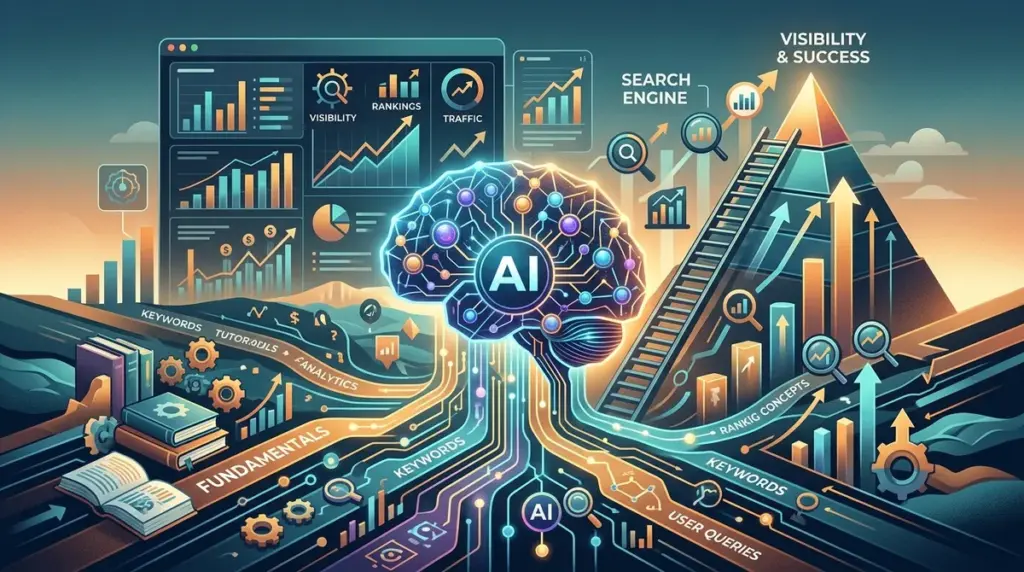
The transition from traditional keyword-based search to generative, AI-driven discovery has fundamentally altered the ROI calculus for digital marketing. For site owners and SEO professionals, the shift is no longer a future projection but a present reality defined by Google’s AI Overviews (AIO) and the rise of Large Language Models (LLMs) as primary information sources. Success now depends on moving beyond simple content production toward a strategy of information gain and entity-based authority.
The Shift from Keyword Matching to Entity-Based Understanding
In the previous era of SEO, ranking was largely a matter of matching specific strings of text to user queries. AI has replaced this narrow focus with entity-based search. Google’s algorithms now use LLMs to understand the relationships between people, places, things, and concepts. When a user searches for "best climate for growing Pinot Noir," the engine isn't just looking for those exact words; it is identifying the entity "Pinot Noir," its biological requirements, and the geographical data of various regions.
Best for: Sites with deep topical authority and structured data. To compete, you must define your brand as a primary entity within your niche. This involves consistent naming conventions, robust "About" pages, and clear connections to other recognized entities in your industry.
AI Overviews and the Zero-Click Reality
Google’s AI Overviews (formerly SGE) are designed to provide a synthesized answer directly on the SERP, often pushing organic blue links below the fold. This creates a "zero-click" environment where the user gets their answer without ever visiting a website. However, this is not the end of organic traffic; it is a refinement of it. Traffic that does click through from an AI Overview is typically higher intent and further down the conversion funnel.
Optimizing for AI Citations
To be cited within an AI Overview, content must be structured for high "extractability." AI models look for clear, factual statements that can be easily summarized. Using a "summary-first" approach—where the direct answer to a query is provided in the first paragraph—increases the likelihood of being pulled into an AI response. This is a departure from the "long-form for the sake of length" strategy that dominated the last decade.
Warning: Relying on AI-generated content without human oversight creates a "homogenization trap." If your content sounds exactly like the training data the AI already has, the search engine has no reason to link to your site as a unique source. Always prioritize original data, unique case studies, or contrarian expert opinions.
Automating Technical SEO and Data Analysis
AI is not just changing how users find content; it is changing how SEOs manage sites. Large-scale technical audits that once took days can now be processed in minutes using specialized machine learning models. AI excels at pattern recognition, making it an essential tool for identifying crawl budget waste or mapping internal linking structures.
- Schema Generation: AI can automatically generate complex JSON-LD scripts for hundreds of pages based on the on-page content, ensuring search engines understand the context of every product or article.
- Log File Analysis: Machine learning models can parse massive server logs to identify exactly how bot agents are interacting with your site, highlighting bottlenecks that manual reviews might miss.
- Predictive Keyword Research: Instead of looking at historical volume, AI tools now analyze social trends and conversational data to predict which topics will gain traction before they hit traditional keyword databases.
The Role of Information Gain in Content Strategy
Google’s "Helpful Content" updates have reinforced a concept known as "Information Gain." In an AI-saturated web, if your article provides the same information as the top ten results, it offers zero information gain and is unlikely to rank. AI models prioritize content that adds something new to the conversation.
To achieve high information gain, focus on primary research. This includes proprietary surveys, interviews with internal subject matter experts, and unique visual assets like custom diagrams or infographics. AI can summarize text, but it cannot (yet) replicate the nuance of a first-hand experiment or a brand-new industry insight.
Structuring Content for LLM Crawlers
LLMs like GPT-4 and Claude are increasingly being used as search engines themselves. Optimizing for these "answer engines" requires a different technical approach. Ensure your site’s robots.txt allows for AI crawlers if you want your brand to be part of their training set or real-time search results. Use clear, declarative headings and avoid overly flowery prose that can confuse a machine’s semantic analysis.
Building a Future-Proof SEO Roadmap
The most effective way to adapt to AI-driven SEO is to pivot from being a content creator to being an information architect. Start by auditing your current top-performing pages to see if they are being cannibalized by AI Overviews. If they are, update them with unique data points that the AI cannot synthesize on its own. Double down on technical health, specifically focusing on Page Experience signals and structured data, as these provide the "scaffolding" that AI needs to trust your content.
Finally, diversify your traffic sources. While Google remains the primary driver, the growth of AI-integrated platforms means your brand needs to be visible wherever users are asking questions—whether that is a traditional search bar, a voice assistant, or a generative chat interface.
Common Questions Regarding AI and Search
Does Google penalize AI-generated content?
No, Google’s official stance is that it rewards high-quality content regardless of how it is produced. However, low-effort AI content that lacks original insight often fails to meet the "Helpful Content" criteria and will struggle to rank as a result.
How can I track my visibility in AI Overviews?
Standard rank tracking is evolving to include "pixel-depth" and "feature-based" tracking. You should monitor your Search Console data for "Impressions" vs. "Clicks" to see if your content is appearing in AI summaries, even if it doesn't result in a traditional click.
Will AI make SEO obsolete?
SEO is not becoming obsolete; it is becoming more technical and strategic. As long as there is an interface between a user and a database of information, there will be a need to optimize that information for better discovery and relevance.