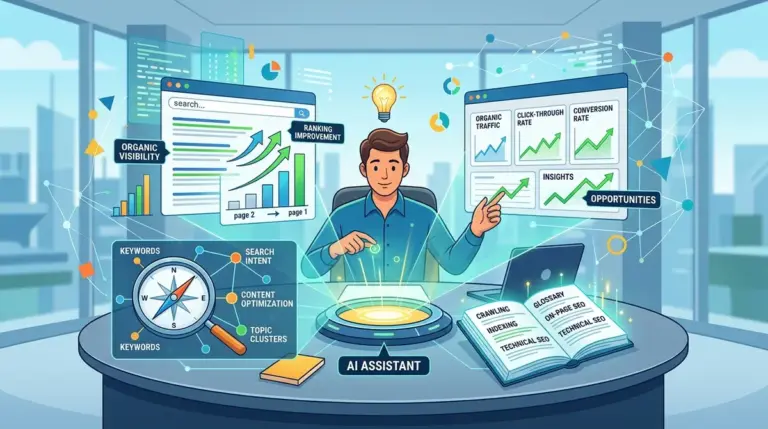
The learning curve for search engine optimization is notoriously steep because the discipline sits at the intersection of technical engineering, creative writing, and data analysis. Traditional learning methods—reading documentation or watching 40-hour courses—often fail because they lack immediate feedback loops. Using Large Language Models (LLMs) like ChatGPT, Claude, or Gemini changes this by providing a real-time, conversational tutor that can deconstruct complex documentation into digestible analogies or troubleshoot technical errors on the fly.
Deconstructing Technical SEO Concepts with Analogies
Technical SEO is often the biggest hurdle for beginners. Concepts like canonicalization, hreflang tags, and crawl budget can feel abstract. To learn faster, use AI to bridge the gap between what you know and what you are trying to master. Instead of reading a dry definition, prompt the AI to explain the concept using a specific mental model you already understand. This approach can significantly accelerate your journey using AI to learn SEO by making complex topics more accessible.
Example Prompt: "Explain how a 301 redirect works versus a 302 redirect using a physical retail store as an analogy."
By forcing the AI to use a non-technical framework, you solidify the underlying logic before worrying about the code syntax. This method ensures you aren't just memorizing definitions but understanding the impact on user experience and bot behavior. Once the logic is clear, you can ask the AI to show you the specific .htaccess or Nginx configuration to implement it, effectively learning the "why" and the "how" in a single session.
Accelerating Technical Literacy with AI-Generated Code
Most SEOs do not need to be full-stack developers, but they must be "code literate." AI allows you to learn by reverse-engineering. If you are struggling to understand how to implement JSON-LD Schema markup, don't just copy a template. Provide the AI with your page details and ask it to generate the code and explain what each line does.
- Regex for Google Search Console: Use AI to write Regular Expressions to filter your performance data. Ask: "Write a Regex for GSC that shows queries containing 'how' or 'why' but excluding my brand name, and explain how the syntax works."
- Robots.txt Simulation: Paste your robots.txt file and ask the AI: "If I am a Googlebot trying to crawl /private-folder/page-1, will I be blocked based on these rules? Explain the logic."
- Sitemap Validation: Use AI to identify syntax errors in an XML sitemap export, helping you learn the strict requirements of sitemap protocols without manual line-by-line auditing.
Warning: AI models frequently hallucinate technical specifications or suggest deprecated attributes. Always cross-reference AI-generated code with official Google Search Central documentation before implementing changes on a live production site.
Mastering Search Intent Through Comparative Analysis
Understanding search intent is the difference between a high-ranking page that converts and one that simply bounces. You can use AI to accelerate your "intent intuition" by feeding it the top three ranking URLs for a keyword and asking for a structural breakdown. This teaches you to see the patterns that Google’s algorithm prefers for specific queries.
Instead of guessing why a competitor ranks, ask the AI to: "Analyze these three meta descriptions and H1 tags. What is the common emotional hook or utility they are promising the searcher?" This exercise trains your brain to look for semantic signals rather than just keyword density. Over time, you will start to recognize these patterns without the AI’s help, which is the definition of skill acquisition.
Building a Personal SEO Glossary and Knowledge Base
As you encounter new terms like "LSI keywords" (and why they are a myth) or "Core Web Vitals," use the AI to build a personalized glossary. However, the key to learning faster is to ask for "Non-Examples." Ask the AI: "What is the difference between a Backlink and a Citation? Give me an example of a link that is a backlink but not a citation."
This "contrast learning" prevents the common mistake of conflating similar terms. You can also use AI to quiz you. Paste a paragraph of a complex SEO article and ask the AI: "Generate three multiple-choice questions based on this text to test my comprehension of the 'E-E-A-T' principles mentioned." This active recall is scientifically proven to move information from short-term to long-term memory faster than passive reading.
Simulating Site Audits for Practical Experience
The best way to learn SEO is by doing, but you might not have access to a dozen different sites. You can simulate the experience by using AI to generate "broken" scenarios. Ask the AI: "Describe a hypothetical website that has lost 40% of its traffic after a core update. Provide five specific technical or content-related data points that could be the cause."
Once the AI provides the scenario, try to "diagnose" the issue. Then, ask the AI for the solution. This role-play environment allows you to practice the diagnostic mindset of a senior SEO strategist without the risk of crashing a real client's website. It builds the "detective" muscles required for high-level consulting.
Establishing an AI-Enhanced Learning Workflow
To turn AI into a permanent learning asset, you must move beyond one-off questions and integrate it into a structured study habit. Start by identifying your weakest pillar—whether it's technical, on-page, or off-page—and dedicate 30 minutes a day to "AI-led interrogation."
Step 1: Identify a high-ranking guide on a topic (e.g., "The Guide to Internal Linking").
Step 2: Paste sections into the AI and ask for a "Summary for a Practitioner" focusing on actionable steps rather than theory.
Step 3: Ask the AI to provide a "Counter-Argument." For example, "What are the risks of over-optimizing internal link anchor text?" This helps you understand the nuances and "gray areas" of SEO.
Step 4: Draft a 200-word summary of what you learned and ask the AI to critique it for accuracy based on current industry standards.
Frequently Asked Questions
Can AI replace the need to learn SEO fundamentals?
No. AI is a tool for acceleration, not a substitute for foundational knowledge. You need to understand the basics to know when the AI is giving you outdated or incorrect advice. Use it to clarify concepts, not to skip the learning process entirely.
Which AI model is best for learning technical SEO?
Claude 3.5 Sonnet and GPT-4o are currently the leaders for technical SEO learning because of their superior coding capabilities and ability to follow complex logical instructions. They are particularly effective at explaining Python scripts or complex Regex patterns.
How do I ensure the AI isn't giving me outdated SEO advice?
SEO changes rapidly. Always prompt the AI to consider "post-2023 Google helpful content guidelines" and verify any specific "rules" it provides against the Google Search Status Dashboard or reputable industry news sites. If an AI suggests "keyword stuffing" or "buying bulk backlinks," you know it is pulling from an outdated training set.
Can I use AI to learn how to use SEO tools?
Yes. You can paste exported CSV headers from tools like Screaming Frog or Ahrefs into the AI and ask: "What does the 'Inlink' count tell me about this URL's priority, and how should I interpret a high 'Crawl Depth'?" This helps you learn the specific metrics of the tools you use daily.