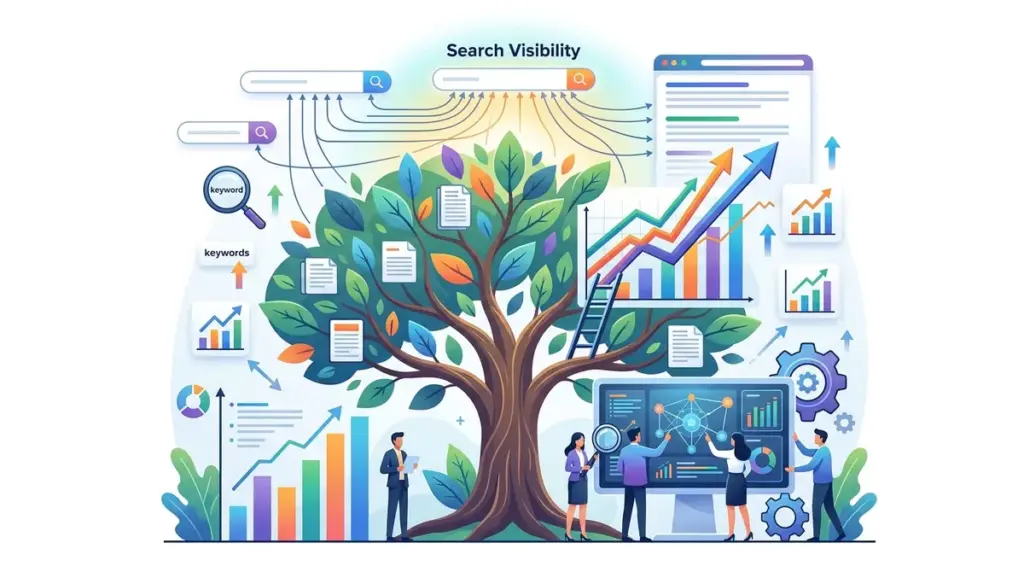
Topical authority is the strategic process of establishing a website as the primary resource for a specific subject area. In modern search engine optimization, Google has shifted from matching keywords to understanding entities and their relationships. This means a single, high-quality page is no longer enough to rank for competitive terms if the rest of the site lacks depth in that niche. To win, a site must demonstrate comprehensive coverage of a topic, answering not just the primary query but all secondary and tertiary questions associated with it.
Best for: Content strategists and site owners looking to move away from "one-off" keyword targeting toward a sustainable, long-term ranking strategy that survives algorithm updates.
The Shift from Keywords to Semantic Entities
Search engines use Natural Language Processing (NLP) to categorize content into entities—discrete objects or concepts that can be uniquely identified. When you build topical authority, you are essentially training the search engine to associate your domain with a specific entity. For example, a site that only writes about "running shoes" will struggle to compete with a site that covers "marathon training," "gait analysis," "blister prevention," and "recovery nutrition."
The latter site demonstrates a higher degree of "information gain." This concept refers to the unique value or data a piece of content provides over what already exists in the search index. If your site consistently provides the next logical step in a user's journey, search engines view your domain as a more authoritative destination for that entire subject matter.
Entity Mapping and Knowledge Graphs
Google’s Knowledge Graph connects billions of entities. When your content covers the breadth of a topic, you are effectively mapping your site to these existing nodes in the graph. This is why niche-specific sites often outrank massive generalist publishers for specialized queries; the specialized site has a denser concentration of relevant entities, creating a stronger topical signal.
Constructing the Pillar-Cluster Framework
The most effective way to organize topical authority is through a hub-and-spoke model, often called the pillar-cluster framework. This structure organizes content into logical groups that satisfy both user intent and crawler efficiency.
- Pillar Pages: These are broad, high-level guides that cover an entire topic at a surface level. They target high-volume, short-tail keywords.
- Cluster Content: These are specific articles that dive deep into subtopics mentioned in the pillar. They target long-tail keywords and specific user problems.
- Hyper-Specific FAQs: These address low-volume but high-intent queries that demonstrate total subject mastery.
For example, if your pillar is "Business Tax Preparation," your cluster content might include "Deducting Home Office Expenses for LLCs," "Quarterly Filing Deadlines for Freelancers," and "How to Reconcile 1099-K Forms." By covering these granular details, you prove to the search engine that you are not just targeting a keyword, but managing a knowledge base.
Warning: Creating content clusters without a logical internal linking structure is a wasted effort. Without links, the search engine cannot see the relationship between your specialized deep-dives and your main pillar pages, leading to "orphaned" content that fails to pass authority.
The Role of Internal Linking in Authority Distribution
Internal links are the connective tissue of topical authority. They do more than help users navigate; they distribute "link equity" or PageRank throughout a cluster. When one page in a cluster earns a backlink from an external source, that authority flows through the internal links to the other related pages.
To maximize this effect, use descriptive anchor text that reinforces the entity relationship. Instead of using "click here" or "read more," use specific terms like "advanced technical SEO audit" or "commercial lease negotiation tactics." This tells the crawler exactly what the destination page is about and how it relates to the current context.
Content Velocity and Historical Significance
Authority is not built overnight. It requires content velocity—the rate at which you publish new, relevant content. A site that publishes ten high-quality articles on a single topic in a month sends a much stronger signal of expertise than a site that publishes one article every three months. Consistency signals to search engines that your site is an active, growing resource in that niche.
Furthermore, historical significance plays a role. The longer your site has consistently provided accurate, updated information on a topic, the more "trust" it accumulates. This is why updating old content is just as important as publishing new pieces. Refreshing a 2022 guide with 2024 data maintains your topical relevance and prevents "content decay," where competitors with fresher information might overtake your rankings.
Measuring Success Beyond Rankings
While ranking for a "head term" is the ultimate goal, it is a lagging indicator. To see if your topical authority strategy is working, you should track more immediate metrics:
Topic Share of Voice: Use SEO tools to see what percentage of the total keywords in a specific niche your site occupies. If you are appearing for 40% of all queries related to "organic gardening," your topical authority is high.
Internal Link Clicks: High engagement with internal links within a cluster suggests that your content is successfully answering the user’s next question, which reduces bounce rates and increases dwell time.
Natural Backlink Acquisition: Comprehensive resources (like original research or deep-dive tutorials) naturally attract links from other sites. If your cluster content is being cited as a source, you have achieved authority status in the eyes of your peers.
Implementing a Topical Audit
Before creating new content, you must assess your current footprint. A topical audit identifies where your coverage is thin and where you have "authority gaps."
1. Inventory your existing content: Group every page on your site by topic, not by date or category.
2. Identify the gaps: Look at your top competitors. What subtopics are they covering that you have ignored? Use "People Also Ask" boxes in search results to find missing questions.
3. Consolidate thin content: If you have three short articles that cover similar ground, merge them into one comprehensive "power page" to avoid keyword cannibalization.
4. Map the links: Ensure every cluster page links back to its pillar, and the pillar links out to its clusters. This creates a closed loop of relevance.
Topical Authority FAQ
How many articles do I need to establish topical authority?
There is no magic number, but most niches require a minimum of 10 to 15 interconnected pieces of content to show a search engine that you have moved beyond surface-level coverage. Highly competitive niches like finance or health may require hundreds of pages.
Does topical authority replace the need for backlinks?
No, but it makes your backlinks more effective. A site with high topical authority can often outrank a site with more backlinks if the latter’s content is thin or disorganized. Topical authority provides the "relevance" that makes "authority" (backlinks) work.
Can a site have authority on multiple topics?
Yes, but it is harder for smaller sites. Large publishers like the New York Times have authority across thousands of topics because of their massive scale and history. For most businesses, it is more efficient to dominate one "niche" topic before expanding into adjacent ones.
How long does it take to see results from a topical strategy?
Typically, it takes three to six months of consistent publishing and internal linking to see a measurable shift in rankings. Search engines need time to crawl the new structure and re-evaluate the site’s relationship to the specific topic.