The biggest mistake new SEOs make is attempting to master every vertical—technical, on-page, and off-page—simultaneously. This leads to "analysis paralysis" where you spend weeks reading about schema markup without ever publishing a page that can actually rank. To build a career or a profitable site, you must prioritize the skills that provide the highest immediate return on effort. The following sequence focuses on the mechanics of how search engines perceive value before moving into the complexities of site architecture.
The Priority of Search Intent
Before touching a keyword tool, you must understand search intent. Google’s primary goal is to satisfy the user’s query with the most relevant format. If you target a "transactional" keyword (like "buy leather boots") with an "informational" blog post (like "the history of leather boots"), you will never rank on page one, regardless of your backlink profile or site speed. Learning to categorize intent is the single most important skill in SEO.
Best for: Content strategists and site owners who need to avoid wasting resources on unrankable content.
- Informational: The user wants an answer or a guide (e.g., "how to clean suede").
- Navigational: The user is looking for a specific brand or site (e.g., "Nike login").
- Commercial: The user is researching products but isn't ready to buy (e.g., "best DSLR cameras 2024").
- Transactional: The user is ready to make a purchase (e.g., "iPhone 15 Pro price").
Mastering On-Page Optimization Mechanics
Once you understand what the user wants, you must learn how to tell Google that your page provides it. On-page SEO is the most accessible entry point because you have 100% control over the variables. You aren't dependent on third-party developers or external publishers to see results.
Title Tags and Meta Descriptions
The title tag is still one of the strongest relevancy signals. Learn to place your primary keyword near the beginning of the tag to maximize its weight. Meta descriptions do not directly impact rankings, but they are your "ad copy" in the search results. A high click-through rate (CTR) tells Google your result is the most appealing, which can indirectly boost your position over time.
Semantic Header Hierarchy
Do not use H2 and H3 tags for styling or making text bigger. Learn to use them as a table of contents for search crawlers. Your H1 should contain the primary keyword and match the user’s intent. H2s should break down the main subtopics, and H3s should support those subtopics. This structure allows Google to "chunk" your content and potentially award you featured snippets for specific questions within your text.
Pro Tip: Never use more than one H1 tag per page. Using multiple H1s dilutes the topical focus and confuses crawlers about the primary subject of the document. Treat your H1 like a book title and your H2s like chapter headings.
Technical Hygiene and Crawlability
You do not need to be a web developer to learn technical SEO, but you must understand how Googlebot interacts with a site. If a search engine cannot "crawl" (find) or "index" (save) your pages, your content is invisible. Focus on these three pillars first:
1. Robots.txt: Learn how this file acts as a gatekeeper, telling bots which parts of your site are off-limits. Misconfiguring this is the fastest way to accidentally de-index an entire website.
2. XML Sitemaps: This is the roadmap you provide to Google. Learning how to generate and submit a clean sitemap via Google Search Console ensures that new content is discovered within hours rather than weeks.
3. Internal Linking: This is the most underrated technical skill. By linking from a high-authority page (like your homepage) to a new blog post, you pass "link equity" and help the bot discover the new page faster. Learn to use descriptive anchor text rather than generic phrases like "click here."
Keyword Research Beyond Volume
Most beginners look for the highest "Search Volume" and stop there. This is a recipe for failure because high-volume terms are usually dominated by massive brands with million-dollar budgets. To succeed early, you must learn to evaluate "Keyword Difficulty" (KD) and "Long-Tail" opportunities.
Long-tail keywords are longer, more specific phrases (e.g., "best organic dog food for senior labs"). These typically have lower volume but significantly higher conversion rates and lower competition. Learning to find these "pockets of opportunity" allows a new site to gain traction and start generating traffic while the broader, more competitive terms are still out of reach.
The Fundamentals of Link Authority
Backlinks are essentially "votes of confidence" from other websites. While link building is the hardest part of SEO, you need to understand the difference between a high-quality link and a toxic one. A single link from a relevant, high-traffic site in your niche is worth more than 1,000 links from "link farms" or unrelated forums.
Focus your initial learning on "E-E-A-T" (Experience, Expertise, Authoritativeness, and Trustworthiness). Google uses these signals to determine if a site is a reliable source of information. Understanding how to demonstrate your credentials on your "About" page and through your content is the first step toward earning the kind of links that actually move the needle.
Building Your First 90-Day Learning Roadmap
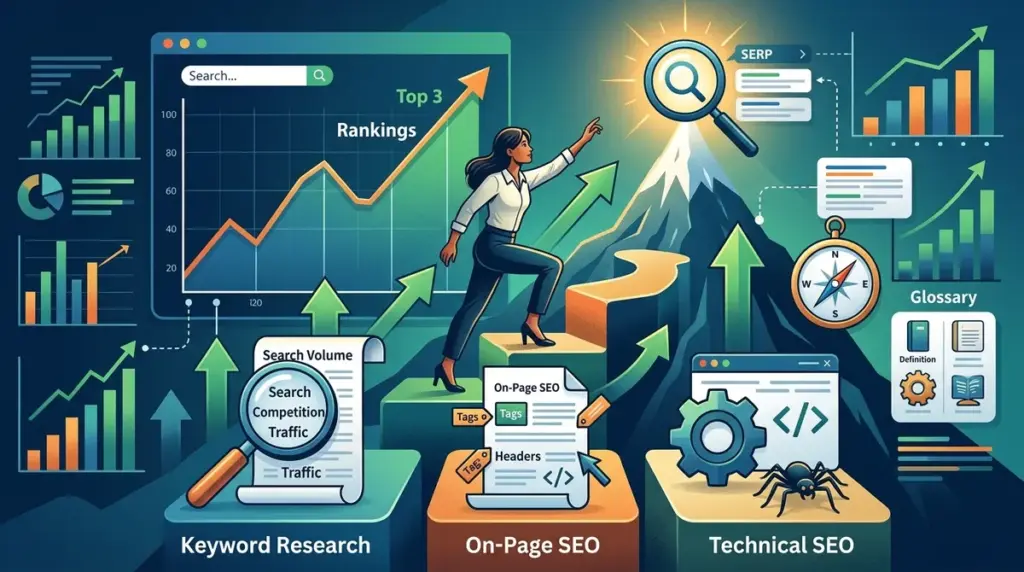
To move from theory to practice, follow this specific order of operations. Spend the first 30 days mastering search intent and keyword research. You cannot build a house without a blueprint, and these two skills form that foundation. In the second month, focus entirely on on-page execution—writing headers, optimizing images, and refining meta data on a live site. In the final 30 days, dive into Google Search Console to monitor how your changes affect impressions and clicks. This feedback loop is where the real learning happens; seeing a line move up in a chart is more educational than any textbook or course.
Frequently Asked Questions
Do I need to learn coding to do SEO?
No, you do not need to be a coder. However, a basic understanding of HTML (specifically tags like <a>, <h1>, and <img>) and how CMS platforms like WordPress work will give you a significant advantage when communicating with developers or making site changes yourself. If you're wondering about this, learning SEO without coding is definitely achievable with the right approach.
How long does it take to see results from SEO?
For a new website, it typically takes 4 to 12 months to see significant organic traffic. SEO is a cumulative process. Initial efforts focus on indexing and building trust, while later efforts focus on ranking for competitive terms once the site has established authority.
Which SEO tool should I buy first?
Start with the free tools provided by Google: Google Search Console and Google Analytics. These provide the most accurate data regarding how Google sees your site. Once you understand how to interpret this data, you can invest in third-party research tools for competitive analysis and keyword discovery.
Is link building still necessary in 2024?
Yes. While content quality is vital, links remain one of the top three ranking factors in Google's algorithm. However, the focus has shifted from quantity to quality. A few high-authority, relevant links are now far more effective than high-volume, low-quality link schemes.